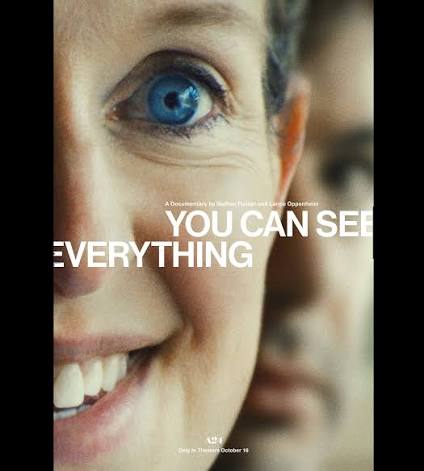
You Can See Everything

You Can See Everything is LONG. Dramatic pauses make it seem even longer than it is.

But if you have three hours to devote to a documentary about convicted fraudster Elizabeth Holmes, you will find there’s much real-life drama to be unwrapped here. Questions are answered. More are raised. 

Does Holmes really believe she committed no crime? Does her partner Billy Evans share that belief? Are they seriously making plans for Theranos 2.0? Or are they both just master bullshitters? Watch the film and then you be the judge. 

Nathan Fielder who is her on-camera interrogator (and co-director of the film) serves as a probing, confrontational skeptic as the film unspools. Later though, after spending considerable time with Holmes and her partner Billy Evans, he appears to have softened his feelings toward her. A variation of Stockholm Syndrome?

You Can See Everything is really a two-part movie. In the first part, in 2023, Fielder and his camera/audio crew begin wall-to-wall coverage of Holmes and Evans, who are spending their final few weeks together before she is to be incarcerated in a federal lockup in Texas. Partway in, Fielder moves into the adjoining guest house. In the second part of YCSE, after she’s in prison, Fielder probes more deeply into Evans and his psyche. And in a genius move, Fielder brings in actress Amanda Seyfried.

The Dropout, a 2022 TV miniseries, starred Seyfried as Holmes who famously dropped out of Stanford to lead Theranos, a startup that achieved a peak valuation of $9 billion, according to Google AI. You Can See Everything shows Holmes (the real life version) watching some of that show before shutting it off.

Fielder recruits Seyfried to recreate several of Fielder’s conversations with Holmes. And Seyfried embraces the mission with gusto. Not just his phone chats which were transcribed when Holmes called from prison but also his in-person visits with her at the prison. Seyfried also offers some of her personal takes in conversations with Fielder. Her participation makes the film richer in its examination of Holmes and Evans. 

As with any such documentary for which hours and hours of content were recorded, one has to wonder what did not make it into the final film version. Were there segments sympathetic (or unsympathetic) to Holmes and/or Evans that did not make the final cut? Were there comments from Elizabeth Holmes’s parents, both of whom appear on camera, that might have shed more light on her actions? 

The best documentaries have a point of view. YCSE offers a number of viewpoints to be sifted through. Yes, she’s a convicted criminal who engaged in fraud, but Holmes also has a human side not revealed in earlier coverage of her work and her life. She was a brilliant entrepreneur who snookered investors from many walks of life, but she was clueless when trying to understand the humor in the classic Who’s On First comedy routine. She’s a villain, yes, but she’s also a caring mom whose two young kids see her only in short visits.

And what about Billy? He’s her loyal mate. While she’s in the slammer he watches the kids. His sex life involves Pam Anderson videos, he reveals. Some of his comments that he shares with Fielder sound a bit unhinged. Is he a flaming a-hole? Is he her best hope for success after she does her time?

In the six or so weeks since YCSE was shown in a surprise screening at the Telluride Film Festival, the film has garnered considerable buzz. And rightly so. While it has similarities to other films and TV shows shot by embedded crews, the inclusion of Seyfried adds a special flavor. Fielder’s handling of the conversations with Holmes and Evans is brilliant. There are some uncomfortable gaps that a less patient interviewer might’ve felt obliged to fill in or to remove in editing.

You Can See Everything, directed by Fielder and Lance Oppenheim, is rated R.

The Social Reckoning

Is Facebook evil? Well, yes and no.

It connects people. It informs people. You may have, in fact, clicked on a link posted on Facebook to find this review of the new movie The Social Reckoning. But Facebook is guilty of many sins, several of which are explored in this film.

Its leader Mark Zuckerberg (Jeremy Strong) is portrayed in The Social Reckoning as a hard-nosed strongman whose mission is to grow Facebook’s user numbers and its stock price. 

Aaron Sorkin, who wrote the script and directed the movie, shows Zuckerberg’s boardroom meetings in stark black-and-white. The most telling scenes of Zuck’s ego and insecurity come when he is being prepped for testimony before congressional committees. During that media training, Zuckerberg is peppered with advice from early Facebook investor Charlie Garrigan (Bill Burr) but pushes back against that input.

Wall Street Journal reporter Jeff Horwitz (Jeremy Allen White) arrives in San Francisco to investigate what’s going on at Facebook. He messages numerous employees via LinkedIn and gets one response, from Frances Haugen (Mikey Madison).

She believes in Facebook as a force for good, for connecting people. But she sees the dark side, too, and begins sharing information with Horwitz. She even chooses to move beyond being an anonymous source to being identified as a whistleblower.

Zuckerberg regards Facebook as a vessel for content though not the generator of that content. He calls the platform a “corkboard.” But Haugen’s inside info shows that Facebook controls who sees what. And that leads to Trump and the January 6 riot at the U.S. Capitol building. Clips depicting that event are included in the film.

Two big differences between this film and 2010’s The Social Network:

The earlier film shows Zuckerberg (played by Jessie Eisenberg) as an energetic young college student, maneuvering to seize control of the emerging platform. The new film shows him as a more settled adult. Also, in 2010 Facebook was still new and fresh, unknown to many and less known than now even to heavy users. Today Facebook and its sibling Instagram are part of popular culture, accessed daily by a large portion of the world’s population. (Sorkin wrote the screenplay for the the 2010 film which was directed by David Fincher.) 

The Social Reckoning is the sort of movie that, considering its story, could just crawl but it moves along at a good, tight pace, clocking in at just under two hours. There are a few humorous throwaway lines which are worth a few chuckles. Curiously, Madison who played a sex worker in the film Anora, shows up for some of her meetings with Horwitz in provocative attire—Sorkin’s attempt to add a bit of allure to her character?

Unlike with the buzzy at the time 2010 Facebook movie, there may be less urgency to see The Social Reckoning. Not that it is flawed but because much of its tale has been told already. The Social Reckoning is rated R.

Digger

In the first few days following its release, Digger has become moviedom’s most polarizing film since Napoleon Dynamite. And, as was the case in 2004 with that oddball comedy, the extreme opinions shared about Digger make it a film that must be seen.

Either to join the chorus of those who offer angry putdowns of the film as a misguided ego trip. Or to praise the film as a work of genius. Which is it? 

The creativity of Digger cannot be denied. It is filled with memorable scenes and memorable lines of dialogue. The structure of the film which is gradually revealed is clever. Oh, there are clues along the way but some are subtle and part of the suspension of belief that is necessary when viewing many films, even those that are more direct in their exposition. 

The transformation of Tom Cruise from a fit, athletic action movie star to an overweight middle-aged guy with thinning hair is an impressive prosthetic trick. You saw Tom in his underwear in Risky Business but this version of Tom in he underwear is not so sexy. And his Texas accent is spot on.

But, is the movie… um, good? Um, yes.

Digger digs (pun intended) into the ecological crisis that the world has been mired in for decades and does it in a way that’s not overly preachy. But the film’s point is clearly made.

Digger Rockwell (Tom Cruise) is awakened with news of a disaster brewing in Greenland. Drilling for oil has caused a chunk of ice to break away and float in the direction of Europe. His reaction is to go into damage control. He consults with the US President Compson (John Goodman) and science consultant Ganesh (Riz Ahmad). 

In a scene that has the feel of a classic movie moment, Digger delivers a passionate speech to a gathering of world leaders, chastising them for failing to embrace alternate energy sources because they are addicted to his product, oil. I was reminded of the passion of Ned Beatty’s speech directed to Peter Finch in Network. One can imagine Digger might even have included Colonel Jessep’s line from another Cruise movie: “You can’t handle the truth!”

The real question this movie asks is “is Tom Cruise Oscar-worthy?” Digger’s director and co-writer Alejandro Iñárritu got Leo his Oscar for The Revenant. He almost got Michael Keaton an Oscar for Birdman. (Keaton was excellent anchoring that best picture winner but lost to an actor playing a more sympathetic character.) 

And now, Tom Cruise, who has never won an Oscar, is making his bid with Digger. Will it work? The film has received numerous pans from critics but its IMDB user rating is 7.3 which is not bad. The old line “it’s an honor just to be nominated” may be true but after a while it must get old. 

In addition to Cruise who does a masterful job with a unique (for him, anyway) role, others in the cast must be lauded. Goodman does not hold back one iota in his over the top performance. Ahmad, Jesse Plemons, Michael Stuhlbarg, among others, add to the overall high level of screen presence.

And how about that soundtrack? Credit Cosmo Sheldrake for the odd music touches, another signal that this is an unusual film.

Digger is rated R. 

Verity

Verity means truth. But in the new movie Verity, what’s true and what’s not true is not always easy to discern. 

Verity Crawford (Anne Hathaway) is a successful novelist. She suffers a debilitating injury. Her husband Jeremy (Josh Harnett) recruits writer Lowen Ashleigh (Dakota Johnson) to take Verity’s notes and outlines and write the novels that Verity had planned. He tells Lowen that Verity was a fan of Lowen’s work. 

Jeremy even invites Lowen to move into the family’s home deep in the woods of Vermont to use Verity’s office and to bunk in the master bedroom. Verity is in another part of the house in a hospital bed with a nurse nearby. Verity does not speak and while she IS alive she appears to be catatonic. 

As Lowen gets to work, she finds a thumb drive that has Verity’s autobiography, written sometime before her disability. She is stunned by what she reads. An added layer to the story: Verity and Jeremy’s young daughter was killed in a boating accident. Their young son survived.

Will there be sparks between Jeremy and this younger woman who, like his wife, is beautiful and has long black hair? And will this younger woman manage to suppress her thoughts about this handsome young husband who is always in close proximity? And what about the suspicion Lowen has that Verity is possibly not as completely out of it as she seems?

The mysterious happenings in the story and the relationships between the characters develop a bit clumsily in the film. Verity is adapted from a book by the prolific Coleen Hoover. One assumes that those developments play out more smoothly on the printed page. 

Hoover is a pop novelist whose sales figures are beyond impressive. At one point in the movie, a disparaging remark is made about “books that are sold in airport bookstores.” Presumably that’s a joke as Hoover likely records huge sales to folks who want something to occupy their minds on a long flight.

It’s not a spoiler to mention that things are not always what they appear to be in Verity. The long and winding road leading up to the house in the woods could be judged to be symbolic of the directions the narrative takes. Or maybe not. Verity is rated R for some sexual content and a bit of nudity.