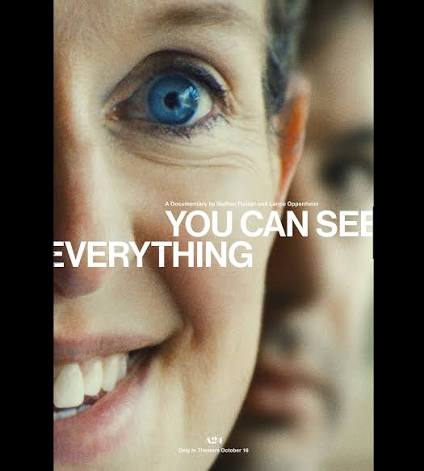
You Can See Everything is LONG. Dramatic pauses make it seem even longer than it is.
But if you have three hours to devote to a documentary about convicted fraudster Elizabeth Holmes, you will find there’s much real-life drama to be unwrapped here. Questions are answered. More are raised.
Does Holmes really believe she committed no crime? Does her partner Billy Evans share that belief? Are they seriously making plans for Theranos 2.0? Or are they both just master bullshitters? Watch the film and then you be the judge.
Nathan Fielder who is her on-camera interrogator (and co-director of the film) serves as a probing, confrontational skeptic as the film unspools. Later though, after spending considerable time with Holmes and her partner Billy Evans, he appears to have softened his feelings toward her. A variation of Stockholm Syndrome?
You Can See Everything is really a two-part movie. In the first part, in 2023, Fielder and his camera/audio crew begin wall-to-wall coverage of Holmes and Evans, who are spending their final few weeks together before she is to be incarcerated in a federal lockup in Texas. Partway in, Fielder moves into the adjoining guest house. In the second part of YCSE, after she’s in prison, Fielder probes more deeply into Evans and his psyche. And in a genius move, Fielder brings in actress Amanda Seyfried.
The Dropout, a 2022 TV miniseries, starred Seyfried as Holmes who famously dropped out of Stanford to lead Theranos, a startup that achieved a peak valuation of $9 billion, according to Google AI. You Can See Everything shows Holmes (the real life version) watching some of that show before shutting it off.
Fielder recruits Seyfried to recreate several of Fielder’s conversations with Holmes. And Seyfried embraces the mission with gusto. Not just his phone chats which were transcribed when Holmes called from prison but also his in-person visits with her at the prison. Seyfried also offers some of her personal takes in conversations with Fielder. Her participation makes the film richer in its examination of Holmes and Evans.
As with any such documentary for which hours and hours of content were recorded, one has to wonder what did not make it into the final film version. Were there segments sympathetic (or unsympathetic) to Holmes and/or Evans that did not make the final cut? Were there comments from Elizabeth Holmes’s parents, both of whom appear on camera, that might have shed more light on her actions?
The best documentaries have a point of view. YCSE offers a number of viewpoints to be sifted through. Yes, she’s a convicted criminal who engaged in fraud, but Holmes also has a human side not revealed in earlier coverage of her work and her life. She was a brilliant entrepreneur who snookered investors from many walks of life, but she was clueless when trying to understand the humor in the classic Who’s On First comedy routine. She’s a villain, yes, but she’s also a caring mom whose two young kids see her only in short visits.
And what about Billy? He’s her loyal mate. While she’s in the slammer he watches the kids. His sex life involves Pam Anderson videos, he reveals. Some of his comments that he shares with Fielder sound a bit unhinged. Is he a flaming a-hole? Is he her best hope for success after she does her time?
In the six or so weeks since YCSE was shown in a surprise screening at the Telluride Film Festival, the film has garnered considerable buzz. And rightly so. While it has similarities to other films and TV shows shot by embedded crews, the inclusion of Seyfried adds a special flavor. Fielder’s handling of the conversations with Holmes and Evans is brilliant. There are some uncomfortable gaps that a less patient interviewer might’ve felt obliged to fill in or to remove in editing.
You Can See Everything, directed by Fielder and Lance Oppenheim, is rated R.