Is Facebook evil? Well, yes and no.
It connects people. It informs people. You may have, in fact, clicked on a link posted on Facebook to find this review of the new movie The Social Reckoning. But Facebook is guilty of many sins, several of which are explored in this film.
Its leader Mark Zuckerberg (Jeremy Strong) is portrayed in The Social Reckoning as a hard-nosed strongman whose mission is to grow Facebook’s user numbers and its stock price.
Aaron Sorkin, who wrote the script and directed the movie, shows Zuckerberg’s boardroom meetings in stark black-and-white. The most telling scenes of Zuck’s ego and insecurity come when he is being prepped for testimony before congressional committees. During that media training, Zuckerberg is peppered with advice from early Facebook investor Charlie Garrigan (Bill Burr) but pushes back against that input.
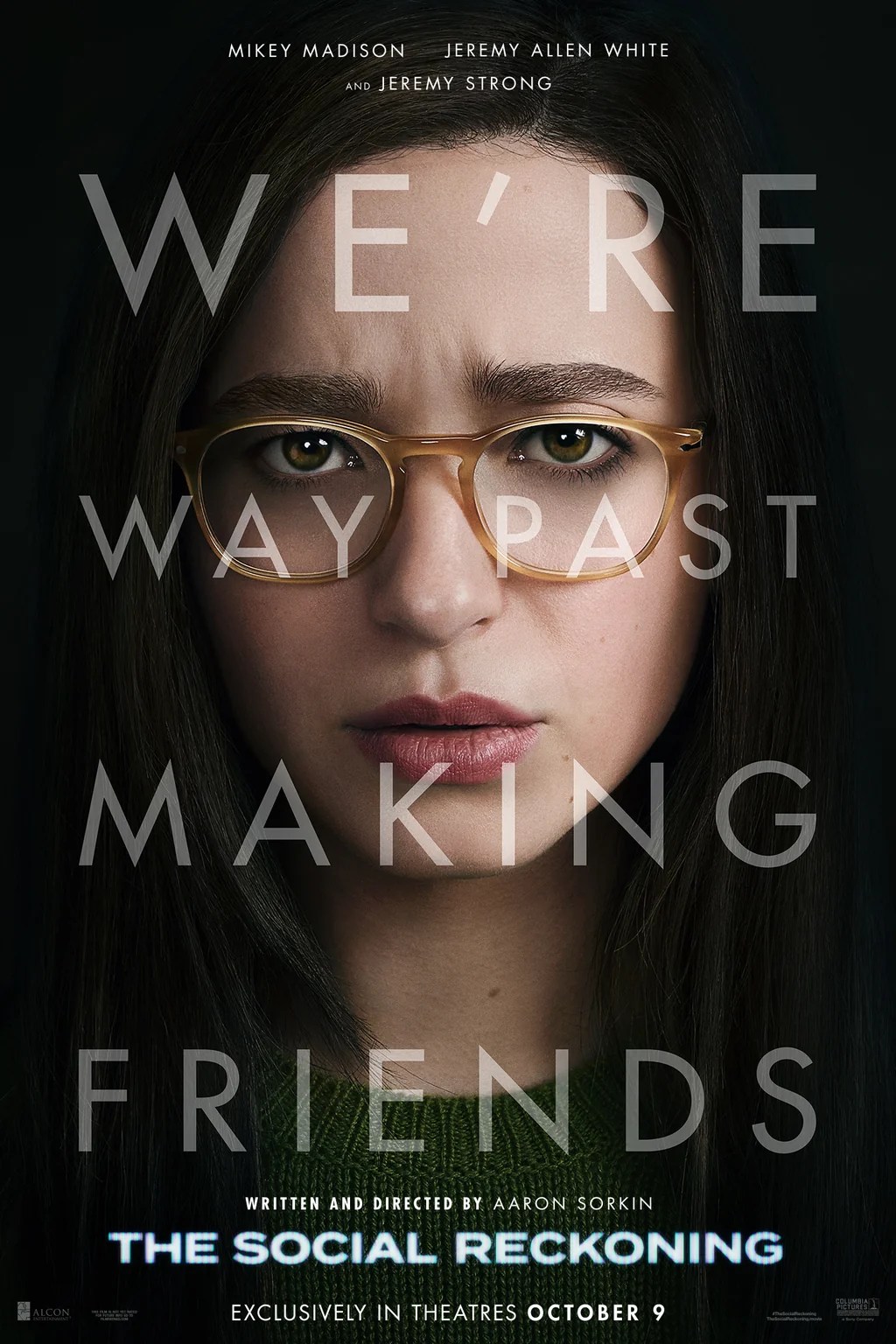
Wall Street Journal reporter Jeff Horwitz (Jeremy Allen White) arrives in San Francisco to investigate what’s going on at Facebook. He messages numerous employees via LinkedIn and gets one response, from Frances Haugen (Mikey Madison).
She believes in Facebook as a force for good, for connecting people. But she sees the dark side, too, and begins sharing information with Horwitz. She even chooses to move beyond being an anonymous source to being identified as a whistleblower.
Zuckerberg regards Facebook as a vessel for content though not the generator of that content. He calls the platform a “corkboard.” But Haugen’s inside info shows that Facebook controls who sees what. And that leads to Trump and the January 6 riot at the U.S. Capitol building. Clips depicting that event are included in the film.
Two big differences between this film and 2010’s The Social Network:
The earlier film shows Zuckerberg (played by Jessie Eisenberg) as an energetic young college student, maneuvering to seize control of the emerging platform. The new film shows him as a more settled adult. Also, in 2010 Facebook was still new and fresh, unknown to many and less known than now even to heavy users. Today Facebook and its sibling Instagram are part of popular culture, accessed daily by a large portion of the world’s population. (Sorkin wrote the screenplay for the the 2010 film which was directed by David Fincher.)
The Social Reckoning is the sort of movie that, considering its story, could just crawl but it moves along at a good, tight pace, clocking in at just under two hours. There are a few humorous throwaway lines which are worth a few chuckles. Curiously, Madison who played a sex worker in the film Anora, shows up for some of her meetings with Horwitz in provocative attire—Sorkin’s attempt to add a bit of allure to her character?
Unlike with the buzzy at the time 2010 Facebook movie, there may be less urgency to see The Social Reckoning. Not that it is flawed but because much of its tale has been told already. The Social Reckoning is rated R.


