You Can See Everything

You Can See Everything is LONG. Dramatic pauses make it seem even longer than it is.

But if you have three hours to devote to a documentary about convicted fraudster Elizabeth Holmes, you will find there’s much real-life drama to be unwrapped here. Questions are answered. More are raised. 

Does Holmes really believe she committed no crime? Does her partner Billy Evans share that belief? Are they seriously making plans for Theranos 2.0? Or are they both just master bullshitters? Watch the film and then you be the judge. 

Nathan Fielder who is her on-camera interrogator (and co-director of the film) serves as a probing, confrontational skeptic as the film unspools. Later though, after spending considerable time with Holmes and her partner Billy Evans, he appears to have softened his feelings toward her. A variation of Stockholm Syndrome?

You Can See Everything is really a two-part movie. In the first part, in 2023, Fielder and his camera/audio crew begin wall-to-wall coverage of Holmes and Evans, who are spending their final few weeks together before she is to be incarcerated in a federal lockup in Texas. Partway in, Fielder moves into the adjoining guest house. In the second part of YCSE, after she’s in prison, Fielder probes more deeply into Evans and his psyche. And in a genius move, Fielder brings in actress Amanda Seyfried.

The Dropout, a 2022 TV miniseries, starred Seyfried as Holmes who famously dropped out of Stanford to lead Theranos, a startup that achieved a peak valuation of $9 billion, according to Google AI. You Can See Everything shows Holmes (the real life version) watching some of that show before shutting it off.

Fielder recruits Seyfried to recreate several of Fielder’s conversations with Holmes. And Seyfried embraces the mission with gusto. Not just his phone chats which were transcribed when Holmes called from prison but also his in-person visits with her at the prison. Seyfried also offers some of her personal takes in conversations with Fielder. Her participation makes the film richer in its examination of Holmes and Evans. 

As with any such documentary for which hours and hours of content were recorded, one has to wonder what did not make it into the final film version. Were there segments sympathetic (or unsympathetic) to Holmes and/or Evans that did not make the final cut? Were there comments from Elizabeth Holmes’s parents, both of whom appear on camera, that might have shed more light on her actions? 

The best documentaries have a point of view. YCSE offers a number of viewpoints to be sifted through. Yes, she’s a convicted criminal who engaged in fraud, but Holmes also has a human side not revealed in earlier coverage of her work and her life. She was a brilliant entrepreneur who snookered investors from many walks of life, but she was clueless when trying to understand the humor in the classic Who’s On First comedy routine. She’s a villain, yes, but she’s also a caring mom whose two young kids see her only in short visits.

And what about Billy? He’s her loyal mate. While she’s in the slammer he watches the kids. His sex life involves Pam Anderson videos, he reveals. Some of his comments that he shares with Fielder sound a bit unhinged. Is he a flaming a-hole? Is he her best hope for success after she does her time?

In the six or so weeks since YCSE was shown in a surprise screening at the Telluride Film Festival, the film has garnered considerable buzz. And rightly so. While it has similarities to other films and TV shows shot by embedded crews, the inclusion of Seyfried adds a special flavor. Fielder’s handling of the conversations with Holmes and Evans is brilliant. There are some uncomfortable gaps that a less patient interviewer might’ve felt obliged to fill in or to remove in editing.

You Can See Everything, directed by Fielder and Lance Oppenheim, is rated R.

The Social Reckoning

Is Facebook evil? Well, yes and no.

It connects people. It informs people. You may have, in fact, clicked on a link posted on Facebook to find this review of the new movie The Social Reckoning. But Facebook is guilty of many sins, several of which are explored in this film.

Its leader Mark Zuckerberg (Jeremy Strong) is portrayed in The Social Reckoning as a hard-nosed strongman whose mission is to grow Facebook’s user numbers and its stock price. 

Aaron Sorkin, who wrote the script and directed the movie, shows Zuckerberg’s boardroom meetings in stark black-and-white. The most telling scenes of Zuck’s ego and insecurity come when he is being prepped for testimony before congressional committees. During that media training, Zuckerberg is peppered with advice from early Facebook investor Charlie Garrigan (Bill Burr) but pushes back against that input.

Wall Street Journal reporter Jeff Horwitz (Jeremy Allen White) arrives in San Francisco to investigate what’s going on at Facebook. He messages numerous employees via LinkedIn and gets one response, from Frances Haugen (Mikey Madison).

She believes in Facebook as a force for good, for connecting people. But she sees the dark side, too, and begins sharing information with Horwitz. She even chooses to move beyond being an anonymous source to being identified as a whistleblower.

Zuckerberg regards Facebook as a vessel for content though not the generator of that content. He calls the platform a “corkboard.” But Haugen’s inside info shows that Facebook controls who sees what. And that leads to Trump and the January 6 riot at the U.S. Capitol building. Clips depicting that event are included in the film.

Two big differences between this film and 2010’s The Social Network:

The earlier film shows Zuckerberg (played by Jessie Eisenberg) as an energetic young college student, maneuvering to seize control of the emerging platform. The new film shows him as a more settled adult. Also, in 2010 Facebook was still new and fresh, unknown to many and less known than now even to heavy users. Today Facebook and its sibling Instagram are part of popular culture, accessed daily by a large portion of the world’s population. (Sorkin wrote the screenplay for the the 2010 film which was directed by David Fincher.) 

The Social Reckoning is the sort of movie that, considering its story, could just crawl but it moves along at a good, tight pace, clocking in at just under two hours. There are a few humorous throwaway lines which are worth a few chuckles. Curiously, Madison who played a sex worker in the film Anora, shows up for some of her meetings with Horwitz in provocative attire—Sorkin’s attempt to add a bit of allure to her character?

Unlike with the buzzy at the time 2010 Facebook movie, there may be less urgency to see The Social Reckoning. Not that it is flawed but because much of its tale has been told already. The Social Reckoning is rated R.

Digger

In the first few days following its release, Digger has become moviedom’s most polarizing film since Napoleon Dynamite. And, as was the case in 2004 with that oddball comedy, the extreme opinions shared about Digger make it a film that must be seen.

Either to join the chorus of those who offer angry putdowns of the film as a misguided ego trip. Or to praise the film as a work of genius. Which is it? 

The creativity of Digger cannot be denied. It is filled with memorable scenes and memorable lines of dialogue. The structure of the film which is gradually revealed is clever. Oh, there are clues along the way but some are subtle and part of the suspension of belief that is necessary when viewing many films, even those that are more direct in their exposition. 

The transformation of Tom Cruise from a fit, athletic action movie star to an overweight middle-aged guy with thinning hair is an impressive prosthetic trick. You saw Tom in his underwear in Risky Business but this version of Tom in he underwear is not so sexy. And his Texas accent is spot on.

But, is the movie… um, good? Um, yes.

Digger digs (pun intended) into the ecological crisis that the world has been mired in for decades and does it in a way that’s not overly preachy. But the film’s point is clearly made.

Digger Rockwell (Tom Cruise) is awakened with news of a disaster brewing in Greenland. Drilling for oil has caused a chunk of ice to break away and float in the direction of Europe. His reaction is to go into damage control. He consults with the US President Compson (John Goodman) and science consultant Ganesh (Riz Ahmad). 

In a scene that has the feel of a classic movie moment, Digger delivers a passionate speech to a gathering of world leaders, chastising them for failing to embrace alternate energy sources because they are addicted to his product, oil. I was reminded of the passion of Ned Beatty’s speech directed to Peter Finch in Network. One can imagine Digger might even have included Colonel Jessep’s line from another Cruise movie: “You can’t handle the truth!”

The real question this movie asks is “is Tom Cruise Oscar-worthy?” Digger’s director and co-writer Alejandro Iñárritu got Leo his Oscar for The Revenant. He almost got Michael Keaton an Oscar for Birdman. (Keaton was excellent anchoring that best picture winner but lost to an actor playing a more sympathetic character.) 

And now, Tom Cruise, who has never won an Oscar, is making his bid with Digger. Will it work? The film has received numerous pans from critics but its IMDB user rating is 7.3 which is not bad. The old line “it’s an honor just to be nominated” may be true but after a while it must get old. 

In addition to Cruise who does a masterful job with a unique (for him, anyway) role, others in the cast must be lauded. Goodman does not hold back one iota in his over the top performance. Ahmad, Jesse Plemons, Michael Stuhlbarg, among others, add to the overall high level of screen presence.

And how about that soundtrack? Credit Cosmo Sheldrake for the odd music touches, another signal that this is an unusual film.

Digger is rated R. 

Primetime

Another bravura performance from Robert Pattinson! If you’re a Pattinson fan, here’s one more example for you of his talent and his range as an actor.

Primetime is a behind-the-scenes look at Chris Hansen (Pattinson) and NBC-TV’s To Catch A Predator. Hansen has a healthy ego. He is hungry for TV ratings. And confronting would-be sex offenders on camera turns out to be ratings gold. 

NBC programming chief Jeff Zucker (played by… Jeff Zucker!) makes it clear that he finds Hansen’s show distasteful but that since his work attracts viewers, the show it is about to get a primetime time slot opposite Lost.

A key to Hansen’s efforts comes from his support team and from the decoys he employs to lure the men when they physically show up for sexual favors. Producer Andie (Merritt Wever) and keyboard guru Xavier (Matthew Maher) try to keep the show and Hansen under control. Del (Phoebe Bridgers) and “Decoy Dan” (Skyler Gisando) are bait for the pervs. These four actors bring commendable performances to their roles.

The tale is full of conflicted people. Hansen assumes high moral ground with his “gotchas” but is cheating on his wife. The organization that launched TCAP wants to stop predators but sells thongs on its website. Dan has qualms about what he’s doing but keeps at it to get TV credits and, ultimately, his union card. Andie is loyal to Hansen but ponders a job offer from ABC-TV.

Director Lance Oppenheim adds stylish touches to the film without overwhelming it. Hansen has a reddish tone to his face through much of the film. Lighting effects add an air of mystery to the later scenes of the movie. Parts of the film have the feel of a documentary. (Oppenheim’s prior works have been docs.) TV camera perspectives and hand-held camera shots add energy to what would otherwise be static scenes. 

The script is by Ajon Singh based on an Esquire magazine article about the TV show and Hansen. Rooted in true events, the film has dramatic embellishment. Not that that’s a bad thing.

As Zucker tells Hansen in the film, TV was changing in the early part of this century. Spending less money on “reality” TV shows not only makes economic sense but also brings plenty of viewers to the various networks. If To Catch A Predator seemed sleazy or sordid back in the day, compare it to what’s on your television as you flip through cable channels tonight (or to what’s on certain true crime podcasts) and maybe reconsider your appraisal.

Primetime is rated R for various sexually related elements and one scene of graphic male nudity.

Coyote vs. Acme

Coyote vs. Acme is an excellent film. It’s funny, it’s clever and it features cartoon characters we’ve known and loved for decades. And it features some fine work from all the humans involved as well.

Melding cartoon characters onscreen with live action people has not always been done well but in Coyote vs. Acme, the toons and the actors share the same world seamlessly. 

However… seeing and enjoying this great new movie leads to the question: why did Warner Brothers bury it? Oh, supposedly it was an accounting thing. Corporations do it all the time. But, typically, if a company takes a “write down,” it’s for a product or service that has not done well in the marketplace. This movie never even got a chance. Only via the efforts of many individuals has Coyote vs. Acme seen the light of day.

You’ve seen the Roadrunner cartoons. Back in the day they ran just before feature film screenings. Wile E. Coyote fails time and time again in his efforts to nab the speedy Roadrunner. He employs numerous devices from Acme corporation. Often, his failures are due to Coyote’s own missteps but frequently they are the results of flawed products from Acme. Coyote generally suffers severe physical damage.

In Coyote vs. Acme, the frustrated Coyote hires small time Albuquerque attorney Kevin Avery (Will Forte), one of those lawyers whose face is on billboards and TV ads, to seek damages from Acme corporation. Avery’s assistant Paige (Lana Condor) helps keep him on the right track. Acme’s lawyer the arrogant Buddy Crane (John Cena) is condescending in his treatment of Avery, an old law school classmate.

Things go badly for Coyote in the courtroom until a surprise witness shows up in the final act. 

Among the highlights of Coyote vs. Acme are the appearances of numerous Warner Brothers cartoon characters: Daffy, Porky, Bugs, Tweety, Elmer. Plus a personal favorite, Foghorn Leghorn, who is on Acme’s side in this face-off. Also, there’s an animated version of movie great Peter Lorre, a toon who’s been hidden away by Acme for decades.

The whole wacky tale comes from a short story in the New Yorker magazine in 1990 by Ian Frazier. The movie’s script is by Samy Burch and the director is Dave Green. Eric Bauza is the new Mel Blanc. Bauza voices Bugs, Daffy, Elmer, Porky, Tweety and Foghorn Leghorn.

Coyote vs. Acme is a true delight! Fun for all ages. Rated PG.

Crime 101

Crime 101 has all the ingredients. Blended together nicely. Overall, a decent, fast-moving caper film set in Los Angeles. However, there’s nothing particularly distinctive or unique here. It’s good but not quite great. Enjoy Crime 101 for what it is!

The players: Davis (Chris Hemsworth), a jewel thief who robs without killing. Lou (Mark Ruffalo), an observant LAPD detective who is rough around the edges. Sharon (Halle Berry), a wellness-obsessed insurance exec who courts high money clients but has yet to make partner at her firm. Ormon (Barry Keoghan), a violent thug who steps in to pull a theft that Davis passes on. 

Also: Maya (Monica Barbaro), Davis’s girlfriend who can’t figure out what he’s hiding. (She was Joan Baez in A Complete Unknown.) Angie (Jennifer Jason Leigh), Lou’s soon to be ex-wife. And Nick Nolte! He plays Davis’s mentor. So… a pretty good cast here!

The story involves jewel thefts that occur nearby to the 101 freeway, hence the title. The “101” designation on a college course connotes that the material to be covered is basic stuff. And since many of the tropes in Crime 101 are those that provide the foundation for many such stories, it’s an appropriate title. (If rather generic for marketing purposes, to be honest.)

A few plot elements are curious. Like why is it necessary for a cache of diamonds to be couriered in from Antwerp to LA for a rich guy’s wedding to his young trophy wife? On the day of their nuptials? (Except, of course, to provide fodder for the film’s climatic scene!) 

Crime 101 is written and directed by Bart Layton. (From a novella by Don Winslow.) Layton’s upside down cityscapes add a different touch to the skyline/freeway transition shots that many films and TV shows use as punctuation. And one scene late in the film with Hemsworth and Ruffalo is written and performed beautifully—what does each of them know about the other? 

Crime 101 is rated R.

Mercy

The movie Mercy moves fast. As it must. 

In Mercy court in a lawless near future Los Angeles, a defendant—who is presumed guilty—has 90 minutes to prove his/her innocence before an AI judge. Failure to do so results in swift execution. 

Alcoholic LA policeman Chris Raven (Chris Pratt), an early supporter of the Mercy court system, is accused of murdering his wife. Circumstantial evidence makes it look like he did it.

Ah, but in this scenario, he has access to multiple digital platforms as the courtroom clock counts down. 

As in a couple of current TV shows, High Potential and Tracker, the access to cell phone data, CCTV footage, emails, financial transactions, criminal records, etc. is quicker and easier than in real life. In Mercy, from his well-connected courtroom, Raven is able to get that digital info at lightning speed.

How realistic or even imaginable is all that? Not very. But when you consider that twenty years ago iPhones didn’t exist and in a few weeks you will be able to watch this movie on your iPhone, what the near future holds… well, who knows? 

Judge Maddox (Rebecca Ferguson) is the AI judge. Like some of our real life AI, she doesn’t handle nuance well. 

Jaq Diallo (Kali Reis) is Raven’s LAPD partner who provides a link to his investigation in the real world. (Reis co-starred with Jodie Foster in that Alaska-based season of True Detective.)

While the main part of Mercy is set in the Mercy courtroom, the videos and phone calls and surveillance footage take the story into the outside world. And, yes, there is even that classic element of thriller films… a chase scene on LA’s freeways!

The main virtue of the film Mercy is its breakneck pace. Nary a slow moment. And like Chris Raven’s trial, it’s over and done in just over ninety minutes. Also, Chris Pratt is a likable actor. So he’s a good choice for this lead role.

Mercy is a juicy chunk of escapism. Directed by Timur Bekmanbetov. Written by Marco van Belle. Rated PG-13. 

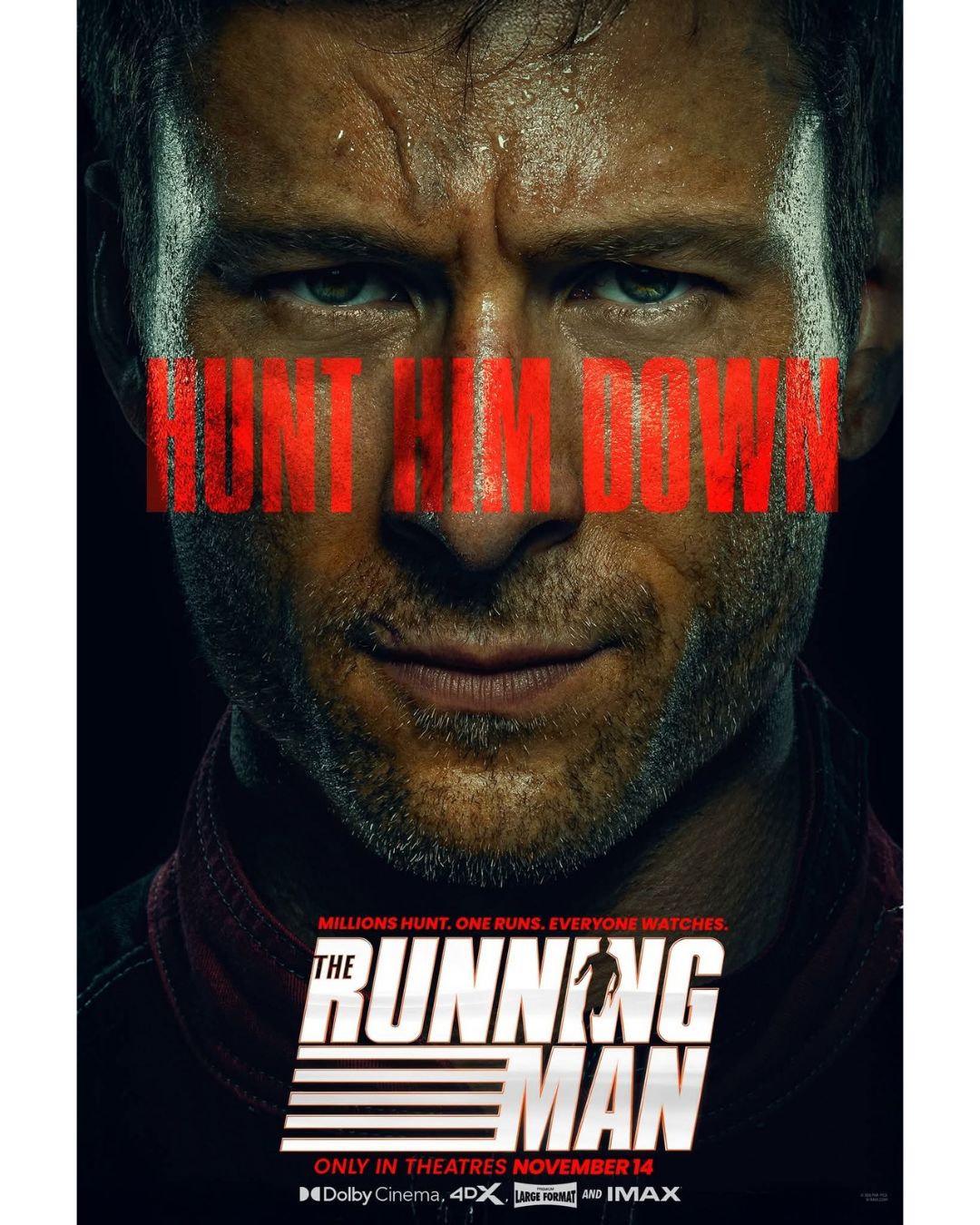
The Running Man

Does America harbor a sadistic society? Are stunt-based TV competitions a last refuge for the desperate? Is “reality” TV real or is it faked? How close are we to a dystopian police state? 

These are legitimate questions one might ask after seeing the new film The Running Man. But if you want to ENJOY the movie, it’s best to table those questions for now and let the almost non-stop action take you along on Ben Richards’s quest for survival. It’s a fun ride with new challenges for The Running Man popping up constantly.

Richards (Glen Powell) is a husband and father whose baby daughter needs meds. He can’t keep a job and keeps getting fired for insubordination. His wife Sheila (Jayme Lawson) works at a strip joint as a waitress. Richards goes to network studios to pursue a spot on a game show and ends up as one of three contestants on The Running Man. The odds that he will survive the hunters who chase him are small but the potential reward is a huge pile of money. 

The film is a revised remake of the 1987 film The Running Man which starred Arnold Schwarzenegger as Richards and Richard Dawson as Damian Killian, the producer and host of the TV show. The new film stars Josh Brolin as producer Dan Killian and Colman Domingo as Bobby, the show’s host. The prize money is in “new dollars” and the currency shown has Schwarzenegger’s photo on it!

Richards’s journey takes him from the dystopian city where he lives to New Hampshire and Maine. The tale is from a book by Bangor resident Stephen King, originally published under the nom de plume Richard Bachman.

Before he hits the road he gets disguises and fake IDs from a crafty anarchist played by the always excellent Willam H. Macy.

In a beautiful old New England home Richards is given refuge by Elton, a strange man played by Micheal Cera whose crazed mother (Sandra Dickinson) ID’s Richards and calls in the Hunters to take him in. For Cera, this is his second odd ball role this year, following his appearance in The Phoenician Scheme back in the spring. 

Richards escapes, ending up in a highway chase, riding with a young woman Amelia (Emilia Jones) before boarding an airplane where he faces off with a prior Running Man contestant Evan McCone (Lee Pace) on his way to the story’s conclusion.

The action is intense and the story moves fast. The movie isn’t exactly one long chase scene but Richards has to stay on the move. A one word review of The Running Man might be “kinetic.” As mentioned, it’s a fun film and Glen Powell is up to the task of carrying it to the finish line. Enjoy it with the large bucket of popcorn.

The Running Man is directed by Edgar Wright, written by Wright and Michael Bacall. Rated R.

Regretting You

The new family drama film Regretting You has some of the hallmarks, um, characteristics of a Hallmark Channel movie. Not that that’s necessarily a bad thing.

A young, attractive cast. Small town setting. Much communication via text messages. Wine drinking. Plus a widow.

And, like many Hallmark films, once the scene is set, you pretty much know where the story is going to go. Getting there is what makes such a film work. Or not. (That, too, is not necessarily a bad thing. I mean… you knew the boat was gonna sink but you watched all three hours of Titanic anyway, right?)

Unlike Hallmark films, Regretting You has sex (but no nudity), drug use and some kissing that’s hotter than what you’ll encounter in Hallmark land. It’s rated PG-13.

Morgan (Allison Williams, daughter of TV newsman Brian) is a thirty-something mom of a 17-year-old daughter Clara (McKenna Grace). Morgan became pregnant with Clara when she was Clara’s age, so she’s overly protective.

Morgan’s life is hit with a double whammy when her husband Chris (Scott Eastwood, Clint’s son) and her sister Willa (Jenny Davidson) die in a car crash. That shock is followed by a life-altering revelation. An old platonic friend of Morgan’s, Jonah (Dave Franco), was involved with sister Willa and he begins showing up often at Morgan’s house.

Meanwhile young Clara is hot to trot and begins a flirtation with fellow high school student Miller (Mason Thames). So mom Morgan has to deal with her own issues and keep a watchful eye on daughter.

The great actor Clancy Brown has a small role in the film. He was a prison guard in The Shawshank Redemption. He supervised the duel at the end of John Wick 4. And, of course, he’s the voice of Mr. Krabs on SpongeBob SquarePants. Always good to see him AND to hear his amazing voice.

Regretting You is based on a book by the prolific best-selling author Colleen Hoover. Unlike the previous Hoover movie It Ends With Us, this new film will hopefully remain free of the bad vibes, controversy and litigation that followed in the wake of its production and release.

A spicier Hallmark sort of movie is how I’d describe Regretting You. If that sounds like something you’d like, check it out.

Good Fortune

Cute, sweet, charming. Words to describe Good Fortune, the new film from Aziz Ansari. He wrote it, directed it and co-stars. Funny? Yes, occasionally.

Good Fortune is a fantasy. A light trifle, but amusing. 

Arj (Ansari) is a gig worker in L.A. He works at a Home Depot type store but also does food delivery and other tasks. He sleeps in his car.

Jeff (Seth Rogen) is a wealthy tech bro who lives in a cool house on a hill. After hiring Arj to clean his garage, he makes Arj his assistant. When Arj uses Jeff’s credit card for an expensive restaurant meal, Jeff fires him.

Gabriel (Keanu Reeves) is an angel. His area of concern is driving and texting and he saves many distracted drivers from danger. But he’s ambitious and oversteps his authorized duty. He arranges for Arj and Jeff to trade places and their respective lifestyles.

Gabriel’s goal is to show Arj that wealth is not that important to one’s happiness but, of course, that backfires and Arj does not want to swap back. After his misstep, Gabriel’s angel boss Martha (Sandra Oh) demotes him to human status, leading to the movie’s funniest scenes.

Keke Palmer is appealing as Arj’s co-worker and romantic interest Elena. 

Reeves and Rogen are talented comic actors whose performances here are spot on. Ansari, whose talents are immense, is not quite the experienced actor as those two guys. But he gives it his best effort and is a likable fellow and in a film like this one, likability goes a long way.

As a director and writer, Ansari could’ve used a real angel on his shoulder to coax him into tightening up the movie a bit and offering a few more funny lines here and there. 

Does Good Fortune offer a real message about economic inequities? Mainly it just reiterates what most of us already know. But if, after seeing this film, you might be likely to tip your DoorDash delivery person or Uber driver more generously, then Ansari will have made his point.

Good Fortune is rated R, mainly for language. Runs just over 90 minutes.