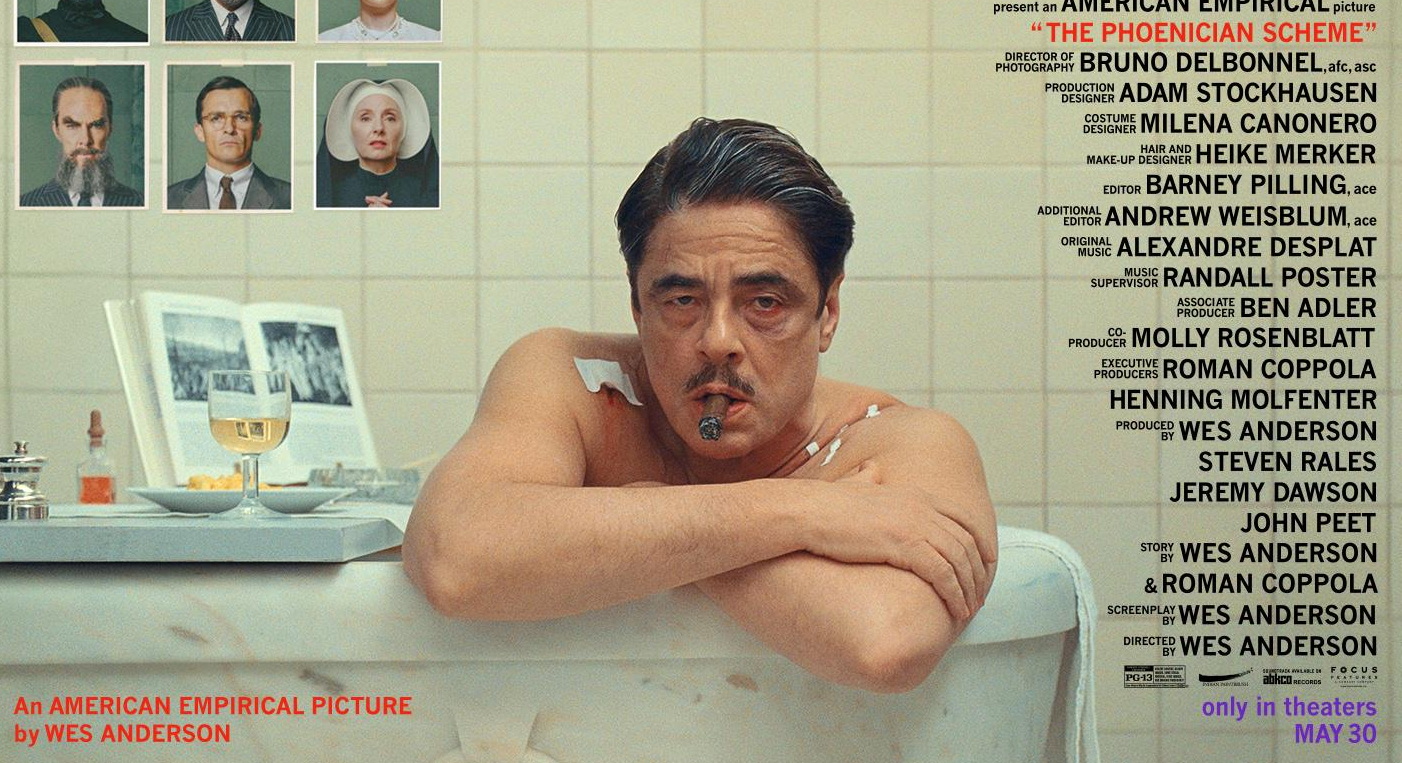
The Phoenician Scheme

Director Wes Anderson dazzles with his zany new movie The Phoenician Scheme. A gaggle of wacky characters zigzag through episodes that are not always laugh-out-loud funny but are consistently bizarre, surprising, compelling and reassuring.

Reassuring, that is, that Anderson can still make a fun film. After his recent lackluster efforts, concern that he may have lost his touch can be put aside for at least one hour and forty-five minutes as Anderson pulls out some of his trademark tricks—overhead shots, tracking shots, maps, oddly titled books etc.—and introduces a few new ones. 

As is his habit, the director employs a large cast of his favorites including Tom Hanks, Bryan Cranston, Jeffrey Wright, Scarlett Johansson, Benedict Cumberbatch, Willem Dafoe and, in a brief appearance in a dream sequence as God, Bill Murray.

This time Anderson puts most of his eggs into one cinematic basket by making Benicio Del Toro the main star who does much of the film’s heavy lifting. He plays Zsa-Zsa Korda, a businessman who has many enemies, some of whom, he claims, are trying to assassinate him. Del Toro’s voice sounds, to my ear, almost exactly like Clark Gable’s.

Korda keeps his business matters in shoeboxes. (Hey, the film is set in the middle of the last century when people DID keep important papers and stuff in shoeboxes. And cigar boxes. Etc.) 

Also receiving an abundance of screen time is Mia Threapleton. Who? She’s the daughter of Kate Winslet and filmmaker Jim Threapleton. She plays Korda’s daughter, Liesl, who is a nun but who also wears red lipstick and heavy eye shadow.  

Korda also has nine sons who mostly stay out of sight and occasionally launch arrows down at Korda from the balcony above his table. What? Silly stuff, that’s what.

Bjorn (Michael Cera) is Korda’s assistant, who is charged with keeping control of a red satchel containing all of Korda’s liquid funds, but who frequently misplaces it.

The plot involves Korda’s lining up an assortment of individuals to get them to buy into his scheme, um, plan to fund a large infrastructure project in Phoenicia. The script is by Anderson from a story he concocted with frequent collaborator Roman Coppola.

Any recommendation of The Phoenician Scheme must be prefaced with the words “if you like Wes Anderson movies.” He has made some good and clever ones such as The Royal Tenenbaums and The Grand Budapest Hotel. If you have enjoyed either or both of those, you may find The Phoenician Scheme to your liking. 

This is a film I would’ve enthusiastically embraced when I was in high school and college. Because I still maintain a certain level of immaturity, The Phoenician Scheme is goofy enough and silly enough to tap into that part of me that goes for the nonsensical. 

I also appreciate the fact that the film’s credits include the names of the housekeeping staff at the hotel where the cast and crew stayed during its production last year in Germany.

The Phoenician Scheme runs an hour and forty-five minutes. Rated PG-13.
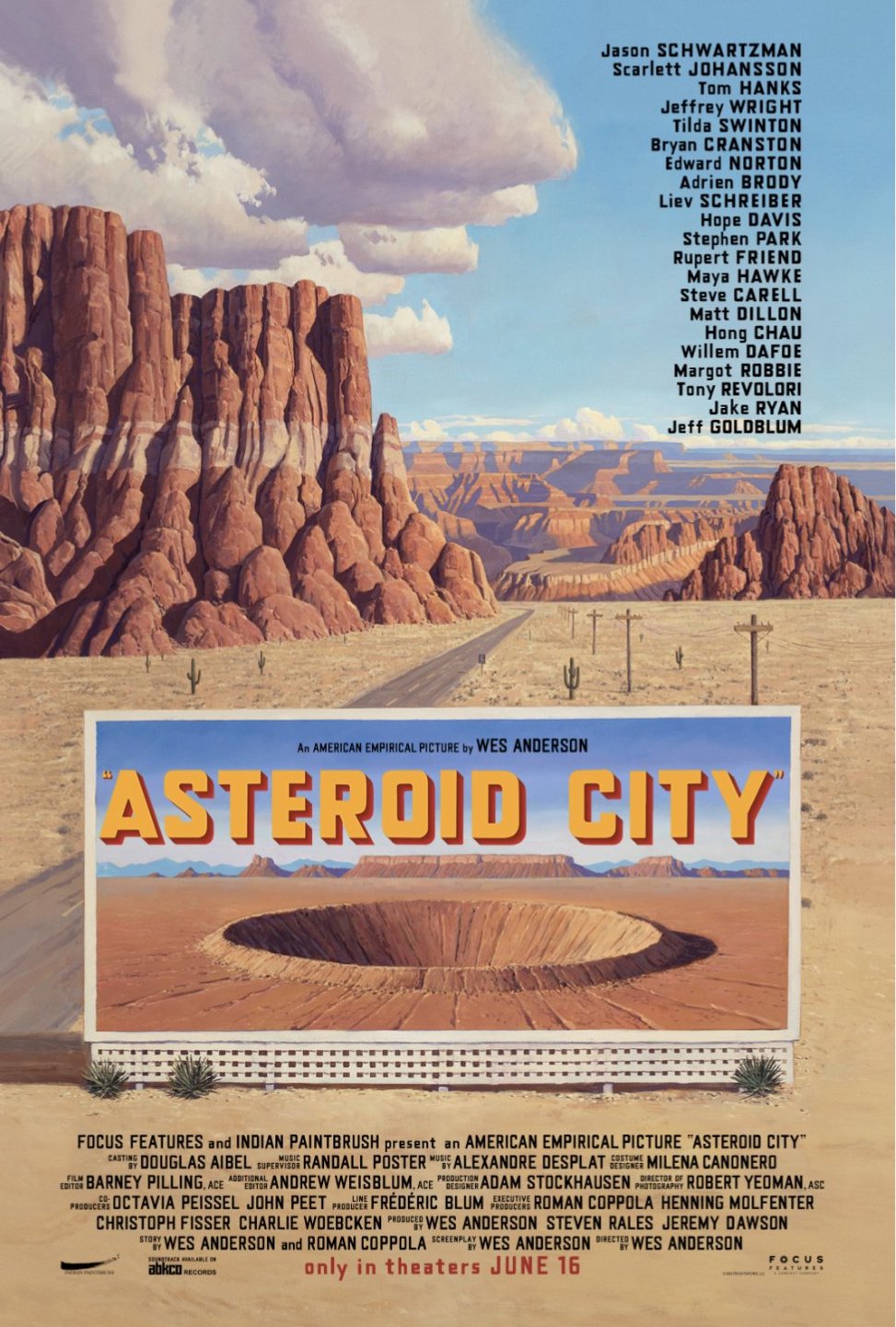
Asteroid City

Asteroid City has all the trademark Wes Anderson elements:

Bright colors, maybe his brightest palette yet. Big cast of notable stars, though no Bill Murray this time. Lateral camera moves, not pans but sideways dollies (trucking is the film school term). And quirkiness galore. 

It is, however, a tedious slog. Have I ever checked my watch more during a movie screening than I did as Asteroid City was unspooling? Not that I can remember.

Unless you are a hardcore loyalist Anderson fan, you might NOT want to head to the movie house to see Asteroid City. Maybe check it out on cable or streaming in a few weeks and see what I mean. Or maybe watch some of those Youtube parody videos of trailers for classic movies if they were directed by Wes.

The framing device for Asteroid City, a black-and-white TV show hosted by a severe Bryan Cranston, appears to have been something Anderson and his co-writer Roman Coppola tacked on to add to the film’s run time. It DOES help cement the story’s setting in 1955 and it DOES give Anderson favorite Edward Norton an easy way to be part of the movie. But clever? Nope, not really. 

The story, set in a tiny town in the Southwest, not far from Monument Valley and not far from A-bomb test sites, centers around a celebration of the anniversary of an asteroid landing nearby which resulted in a giant hole in the ground. 

Among the actors who portray folks who come for the event or are already there are Jason Schwartzman, Scarlett Johanssen, Tom Hanks, Steve Carrell, Liev Schreiber, Tilda Swinton, Willem Dafoe, Matt Dillon and more.

Along with the absence of Bill Murray, there’s a lack of cool and/or obscure tunes added to the soundtrack. The two train songs that run at the beginning and end of the film are fun but that’s about it for music (which has been a part of most Wes movies.)

Anderson’s movies generally have many disparate episodes which don’t necessarily fit neatly together but somehow coalesce to add to an underlying narrative. The happenings in Asteroid City and the characters seem more disconnected than usual and the framing device (the TV show) doesn’t help.

As I have enjoyed some but not all of Anderson’s prior efforts, I had high hopes for this one. But Asteroid City is, for me, a big disappointment. Rated PG-13. 

Toy Story 4

Toy Story 4

“Tell me a story.” Mission accomplished again by Pixar. Toy Story 4 shows that you can go to the sequel well over and over if you keep delivering compelling stories.

Oh, and it helps to have characters who are, by now, not just familiar but also beloved. Cowboy Woody (Tom Hanks) gets the main spotlight in TS4. He’s one of many toys in the closet of young Bonnie (Madeleine McGraw) and he is NOT one of her favorites. But he’s the one who is most concerned about Bonnie’s ability to cope with the pressures of kindergarten orientation.

A handmade toy that Bonnie assembles from a plastic spork and a pipe cleaner becomes her primary concern. “Forky” (Tony Hale) becomes a member of Bonnie’s toy menagerie but he has little self-respect. Woody steps in to help him focus.

Bonnie’s family takes an RV trip to a town with an antique store. The store and its wares provide an intriguing setting for toy adventures.

Woody reconnects with Bo Peep (Annie Potts) and meets new characters Gabby Gabby (Christina Hendricks) and Duke Caboom (Keanu Reaves). The latter two are inspired by Mattel’s Chatty Cathy and the Evel Knievel motorcycle toy that never performed quite as well in real life as on the TV spot.

Buzz Lightyear (Tim Allen) keeps showing up and continues to push a button on his chest that generates a recorded soundbite. He considers this his “inner voice” and takes guidance from those brief gems.

Among the film’s most entertaining voice actors are Keegan-Michael Key and Jordan Peele as a pair of stuffed animals who escape from a carnival game prize wall.

Toy Story 4 is filled with delight and fun surprises from beginning to end. There are a couple of scary situations but the peril is less intense than that seen in Toy Story 3.

Pixar’s animation and tech skills have been a given for a quarter century. Other studios have also turned out impressive images and effects. But it is Pixar’s storytelling ability makes most of their films special.

Toy Story 4 is yet another Pixar winner.

(Note: In a change from the usual Pixar format, there is no animated short running before TS4.)


Sully

When the real-life Chesley “Sully” Sullenberger landed that jet in the Hudson River in January 2009, it was an amazing “feel good” story. He became a hero. Not only was he a capable pilot, he was also a nice guy.

He’s portrayed in Sully by Tom Hanks, a capable actor who also seems to be a nice guy.

Yes, there was drama in the actual incident, but apparently not quite enough for director Clint Eastwood to build a movie around. The story needs… conflict! An essential ingredient for many narratives, the conflict in Sully seems contrived.

While America was enjoying the happy outcome of the emergency landing and Sully was becoming a media darling, that nasty ol’ NTSB had its doubts that the river landing was necessary. The three members of the National Transportation Safety Board played by Mike O’Malley, Anna Gunn and Jamey Sheridan question Sully and co-pilot Jeff Skiles (Aaron Eckhart) about their decision-making.

In informal meetings and in an official hearing, the NTSB team suggests that Sully could’ve made it back to LaGuardia or to Teterboro airport in New Jersey. They even produce flight simulations showing that they could have safely touched down at either airport. Sully cites the human element as the key factor in his choice.

The depictions of the river landing are realistic and provide the meat of the movie. Because of the incident’s happy ending, the film provides a reminder of the tension of the evacuation and rescue effort.

Sully’s concern is for his passengers as they make it safely from the plane and after all have been taken from the river to various locations. In a sweet segment during the closing credits, the real-life Sully and his wife visit with passengers from the flight. Laura Linney plays Mrs. Sullenberger in the film. Her role is small but effective.

Are Sully, its star and its director Oscar-nomination-worthy? Those, I think, will be borderline calls, based on the competitive field. Because Sully was a reserved, medium-key individual, Tom Hanks gives a medium-key performance. Even last year’s role in Bridge of Spies offered more opportunities for Hanks to display his acting chops.

Sully relives the events of that day in 2009 without major stylistic flourishes. This solid film should give American audiences a moment to be proud of and should rekindle the nation’s appreciation for this hero pilot.

Bridge of Spies

With the pedigree Bridge of Spies possesses, it’s no surprise that this is solid filmmaking. Directed by Steven Spielberg. Written by the Coen brothers (with Matt Charman). Starring Tom Hanks.

Filled with memorable scenes depicting the times and specific events of the Cold War era, Bridge of Spies is an “inspired by true events” tale of the competition and distrust between the U.S. and the U.S.S.R.

James Donovan (Hanks) is an attorney in New York chosen in 1957 by his boss Thomas Watters (Alan Alda) to represent Rudolph Abel (Mark Rylance) who is charged by the U.S. with espionage. Watters and Donovan presume he’s guilty, but agree to provide competent counsel. When the verdict is conviction, Donovan privately lobbies the judge against a death sentence for Abel, suggesting that the spy may be of greater value to U.S. interests if he is kept alive.

A few years later, after U.S. U-2 pilot Francis Gary Powers (Austen Stowell) is shot down over the U.S.S.R. and taken prisoner, the U.S. offers to swap Abel for Powers. Donovan is chosen to make the deal.

In East Berlin, shortly after the wall has been erected, Donovan overplays his hand, leading to the story’s tense climax on the real-life Glienicke Bridge.

The events and people in the story are real. The details of the story may be subject to what David Letterman referred to as “writer’s embellishment,” which frequently happens in retellings of history.

The late 50s/early 60s time period is recalled in Bridge of Spies with vintage cars, men wearing hats, lots of smoking, women only in supportive work positions and school kids being taught to duck and cover.

Tom Hanks helps cement his reputation as a bastion of American honesty and fairness, as well as a respected hero. Hanks has been compared to Jimmy Stewart, who generally played good guys who represented American values to moviegoers. Hanks’ Bridge of Spies role is meatier than a typical Stewart role.

Bridge of Spies clocks in around 2:20 but the story never drags. Even the delays in negotiating the prisoner swap only add to the narrative. Yes, Spielberg has made flashier movies, but Bridge of Spies is excellent, entertaining storytelling.

The Martian

Is there such a thing as too much comic relief? Yes, and The Martian is plagued by it.

The Martian has a heck of a story. A NASA mission to Mars chooses to begin its journey home to Earth hurriedly as a giant storm stirs on the red planet. One of the astronauts, Mark Watney (Matt Damon), is blown away by the high winds and left for dead as the others blast off for home.

But, wait! Watney’s not quite dead. He heads back into the Mars mission habitat the next day and evaluates his chances of surviving until the next NASA Mars mission occurs. He constructs an indoor potato farm to provide an ongoing food source and makes other accommodations to stay alive.

Meanwhile, the NASA crew in Houston (Jeff Daniels, Chiwetel Ejiofor, Kristen Wiig, Sean Bean, Donald Glover and others) eulogizes Watney but soon realizes that he is still alive. Watney manages to communicate, crudely at first, with the crew back on Earth.

As the other members of the departed Mars crew (including Jessica Chastain, Michael Pena and Kate Mara) hurdle through space on the long journey home, they learn that Watney is alive and that he does not blame them for abandoning him.

Will Watney stay alive? Will NASA rescue him? Will NASA send him food and supplies? Will NASA move up the next scheduled MARS mission? How will Mark Watney’s story end? The tension builds. But each time it begins to crescendo, here comes the comic relief.

The funny stuff IS amusing. But it lightens the mood a bit too much, in my opinion. (This was an issue with 2013’s Gravity where George Clooney’s jokey character seemed more like the real-life Clooney than a believable astronaut. In 2000’s Cast Away, a similarly stranded Tom Hanks had some lighter moments—notably with a volleyball—but the underlying peril level was maintained throughout his ordeal.)

The Martian looks great, particularly in 3D. It is directed by one of our best directors, Ridley Scott. Matt Damon, as usual, is solid in the title role. The script is by Drew Goddard from the popular novel by Andy Weir. (That’s the one that started in 2011 with the author sharing one chapter at a time online, followed by a Kindle version, followed by publication in hardcover last year.)

The Martian comes close to being a home run, but doesn’t quite clear the fence. It’s a solid three-bagger, however, and that is not a bad thing. (Baseball is on our minds these days here in St. Louis.)

Saving Mr. Banks

How could Saving Mr. Banks be anything but a home run? The story of a beloved movie musical, featuring a beloved actor portraying a beloved entertainment icon would appear to be a slam dunk, no? Oh, and most of the movie is set in a place that almost all Americans of a certain age have visited or fantasized about visiting.

Sorry to report that Saving Mr. Banks is not a good as one might have expected. The making of Mary Poppins with Tom Hanks as Walt Disney, set at Disneyland is a tedious story that could have benefited from a more streamlined script. The movie brings some big fun but also is overloaded with the dour disposition of author P.L. Travers (Emma Thompson). Walt’s best efforts to charm Travers into letting him make Mary Poppins into a Disney movie are met with strong opposition.

A movie that initially promises light-hearted fun adds in an overly long backstory that reveals why Travers is the way she is. Not that the fun stuff isn’t fun—much of it is. The songwriters Richard and Robert Sherman (Jason Schwartzman and B.J. Novak) provide many of the film’s highlights. Travers seems to be slowly warming to the efforts of everybody on the Disney team, including her driver Ralph (Paul Giamatti), only to bolt back to London without agreeing to sell the rights to her beloved book Mary Poppins.

The back story, featuring Colin Farrell as her alcoholic father, is set in century-ago Australia. The flashbacks show us the real life inspiration for Mary Poppins, amid circumstances that are definitely not light-hearted.

Eventually, Disney travels to London in a final effort to close the deal. In the climax of Saving Mr. Banks, Disney tries to relate to Travers on a more personal basis. It’s a touching scene and audience tears will be shed.

We know going in, of course, that the film Mary Poppins was made. It was made the way Walt and his team wanted it made. Saving Mr. Banks serves as an excellent promotional tool for the 50th anniversary of Mary Poppins. SMB adds to the legend of Walt Disney and is likely to increase awareness of Walt among younger generations. (There’s plenty of longtime love for the man among boomers.)

Saving Mr. Banks will likely earn Emma Thompson a best actress nomination. She’s great in a mostly unsympathetic role. And, because the industry loves movies about movies, don’t be surprised to see SMB get a best picture nod. Just don’t go to your theater expecting movie magic. It’s a solid film, but it could’ve been much better.

Captain Phillips

I agree with the blurb on the TV spots—Captain Phillips IS one of 2013’s best films. Tom Hanks turns in his usual strong portrayal, but it’s the guys who play the Somali pirates who help give the film its realism.

Captain Phillips has the three elements that make a good movie: a compelling story, compelling characters and an interesting way of telling of that story.

Captain Phillips is based on a true story, though some of the actual crew members claim that they didn’t get the love they deserved and blame the real-life Captain Phillips. Also: a movie, even one based on real events, takes liberties with characters, timelines and minor details in its storytelling.

Having issued those disclaimers, I can assure you that Captain Phillips sometimes feels like TV news coverage. (Although, unlike many films based on recent real-life occurrences, we do not see clips of TV news reports of the incident.) With many handheld camera shots, plus scenes filmed in close quarters, Captain Phillips has an air of reality that many similar films do not have.

Phillips (Tom Hanks) is a regular guy from Vermont who happens to have a job as a sea captain. As the film opens, we see him riding to the airport with his wife (Catherine Keener) who sends him off to his next trip. He runs a cargo vessel that has to sail in open waters near Somalia. Hanks has great range as an actor, but playing everyman is his sweet spot.

Admirably, director Paul Greengrass also shares the Somali pirates’ backstory. He shows them gathering on the beach, choosing a team and constructing a longer ladder to enable them to board large vessels. During their takeover of the ship and all that follows, the audience comes to know these guys and their motivations. They are not sympathetic characters, but they are not just a bunch of faceless thugs.

Native Somali Barkhad Abdi (now a U.S. resident) plays Muse, the rail-thin leader of the pirate takeover. His machine gun allows him to display some swagger, but his cool helps him calm dissension within his gang of four. Could this unknown be 2013’s version of Quvenzhané Wallis, last year’s awards season darling?

Although you as a moviegoer know in advance that Phillips made it out alive, as with Titanic and Apollo 13, discovering the outcome is not the reason to see Captain Phillips. It’s the journey that each of the characters takes that keeps the tension building right up to the film’s climax. Also, it’s rather cool to see the way U.S. military involvement in the event is depicted.

Sometimes a big star promotes a movie with maximum gusto to generate a decent opening weekend, before ticket buyers figure out that it is not a very good movie. Hanks has been flogging Captain Phillips like crazy in recent weeks. In this case, it is not to salvage a mediocre film but to generate long-term box office. The guess here is that Captain Phillips will have “legs” and that Tom Hanks is in line to get a large percentage of those ticket sales.

In mid-summer, I had only a couple of films on my 2013 “must see” list. Happily, the list has grown in recent weeks. My latest “must see” movie is Captain Phillips.


Life of Pi

“”Life of Pi” is visually stunning and tells an incredible story. But it is not the next “Avatar.”

Director Ang Lee shares many gorgeous images in this movie. From the opening credits with animals galore, to the blendings of sea and sky, to the amazing enchanted island, to the luminous fish—shot after shot is memorable. And the story is pretty good, too.

A clever young man in India shortens his embarrassing first name to “Pi.” He covers his bases with God. He’s a Christian, a Muslim and a Hindu. His family, which owns a zoo, moves to Canada, traveling with their menagerie via freighter. A monster wave sinks the ship and Pi finds himself in a lifeboat with four zoo animals: a zebra, a hyena, an orangutan and a fearsome tiger. The story is related to a writer by an adult Pi, so we know from the outset that he survived the ordeal.

Most of the movie is set at sea, in and around the lifeboat. The survival instincts of this teenager, along with guidance from a book found in the lifeboat, keep him going through numerous frightening episodes. His “relationship” with the tiger fuels the story’s progress to its conclusion.

Suraj Sharma is the Indian actor who portrays the teenage Pi. His performance is a good one for a movie rookie who is charged with carrying the bulk of the movie’s story. Like Tom Hanks in “Cast Away,” he is the only human on screen for most of the movie.

This is a movie to see in 3-D on a big screen. It is, as they say, “a feast for the eyes.” There is peril and a few scenes that frighten, but “Life of Pi” (rated PG) will thrill kids just as much as it does adult viewers.

Early marketing for “Life of Pi” contained a critic quote that compared it to “Avatar.” Both are pretty to look at and both have compelling stories, but “Life of Pi” doesn’t have the heft of “Avatar.” Enjoy “Life of Pi” for what it is… a solidly entertaining movie. A classic? That’s still to be determined.

Cloud Atlas

“Cloud Atlas” is just a big ol’ mess. Its parts are good, but the whole is bad.

If you believe in reincarnation, you might love “Cloud Atlas.” For the rest of us, it’s a movie with cool things and interesting people to look at, but the assembled product lacks real continuity.

The film attempts to tell six stories: some from the past, some from the future. Actors play different roles at various points on the timeline and the audience is expected to connect the dots. Honestly, it’s not worth it.

Last year, we had the polarizing “The Tree of Life,” a movie with interesting parts and incredible images, but, as a whole, was a real head scratcher. It was loved by some, hated by many (including many theater walk-outs).

In 2012, we have “Cloud Atlas.” You can go online now and see numerous blurbs touting this movie’s greatness. I beg to differ.

The star power here is strong: Tom Hanks, Hallie Berry, Hugh Grant, Susan Sarandon, Jim Broadbent, among others. It’s slightly interesting to see these folks play multiple roles, although some of the make-up is laughable. (The facial prosthetics used to make Hugh Grant look like a 70-something are embarrassingly ridiculous.)

The film, directed by Tom Tykwer and the Wachowski siblings who brought us the “Matrix” movies, also features Hugo Weaving in multiple roles—none of which are as memorable as his Agent Smith in the “Matrix” trilogy.

“Cloud Atlas” is like a stew containing several of your favorite food items that just don’t work well together in the same pot. It’s big (nearly three hours long), it’s ambitious, but ultimately unsatisfying.