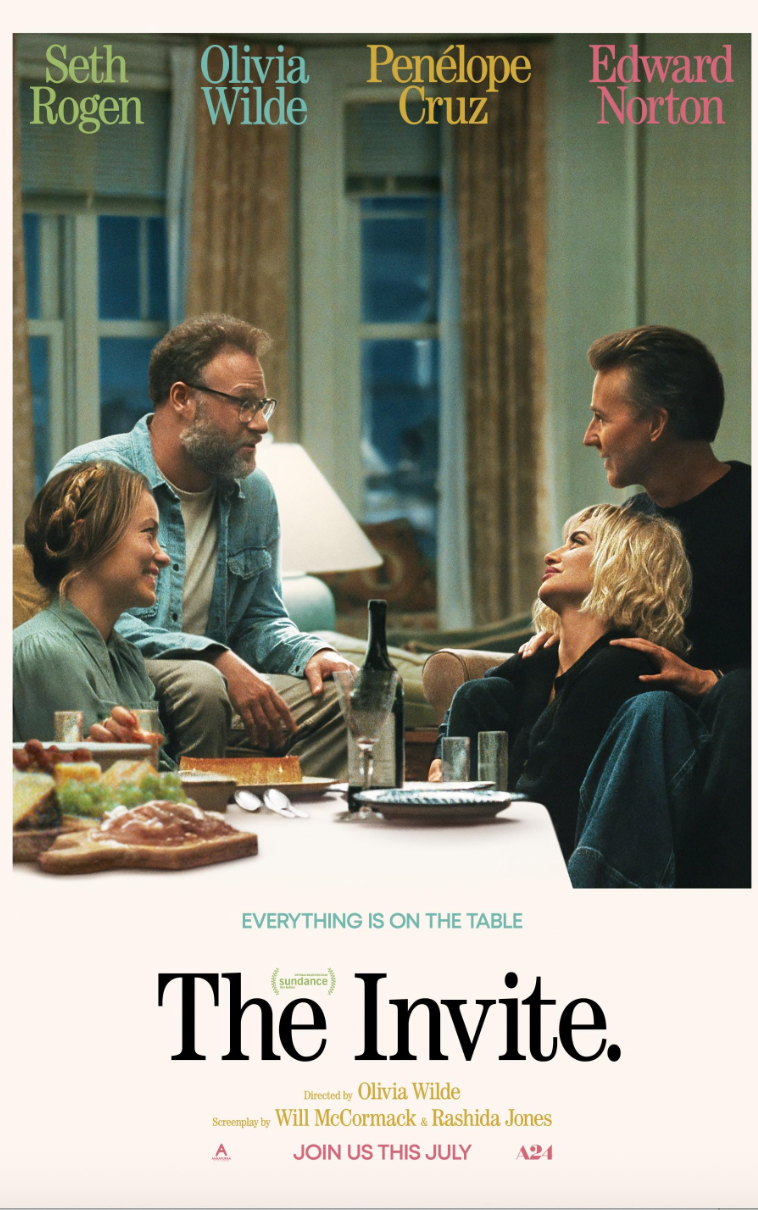
The Invite

Title is wrong. Should be plural. InviteS. Is that a spoiler? No, it’s a tease!

Have you and your mate ever invited another couple over for a visit and realized in short order that it might’ve been a bad idea? Maybe even before the other couple arrives?

Angela (Olivia Wilde) and Joe (Seth Rogen) invite their intriguing upstairs neighbors Piña (a blonde Penelope Cruz) and Hawk (Edward Norton) to join them in their San Francisco apartment for dinner and drinks. Or did they? Joe is confused about the details of the invite and doesn’t seem to remember agreeing to it. 

When the neighbors show up, there’s some initial discomfort as they feel each other out. Not literally—that’s later in the story!

Joe is a frustrated music teacher who once played in a pop music band. Angela is a frustrated visual artist. Hawk is a retired fireman whose current interest is rolfing, a massage therapy. Pina is a sexologist. These are not boring people.

Thanks to an excellent script and talented actors who can convey those lines in skillful ways that make this conversation seem real, the audience listens in on an evening that goes in multiple directions: some hilariously funny, others tense and uncomfortable. 

The elephant in the room is Hawk and Piña’s noisy lovemaking. Will it be addressed? And will it lead to other, possibly dangerous, developments? And maybe another sort of invite?

The apartment itself is a key element of the movie with scenes occurring not just in the main living area. Sometimes a movie set within a limited area can feel like a recycled stage play. The Invite does not. A new rug in that living area gets a good amount of attention. A window in the downstairs apartment provides small views into the upstairs apartment. And, just as importantly, it offers views of Joe and Angela’s apartment from upstairs. Scenes occur in the kitchen, the hallway, Joe’s office and the bedroom.

The Invite is clever and amusing but some moviegoers may cringe when the talk takes a shift to the carnal. How open-minded are you? 

Another qualm: Seth Rogen. He’s funny. But he’s also big. And loud. Would an less boisterous actor have filled that role better? Topic for future discussion!

The Invite is directed by Olivia Wilde whose previous directing efforts include Don’t Worry Darling and Booksmart. The script is by Will McCormack and Rashida Jones (Quincy’s daughter!), adapted from a Spanish film.

The Invite is rated R.

Inside Out

Okay, Pixar is back. They’ve made a great movie again. Inside Out has many things to like and will appeal to audiences of all ages. Unless you are a total curmudgeon, you will be charmed.

The concept, in case you’ve missed the zillion or so TV ads for the film, is a trip inside a young girl’s mind where her various personified emotions face off with one another. It’s a fresh expansion of the old “devil versus angel” bit (fighting for control of a character’s conscience) we saw in numerous mid-20th century cartoons.

Inside the head of young Riley (Kaitlyn Dias) reside Joy (Amy Poehler), Sadness (Phyllis Smith), Fear (Bill Hader), Disgust (Mindy Kaling) and Anger (Lewis Black). Riley’s preteen life is jarred when her parents (Kyle MacLachlan and Diane Lane) move from Minnesota to San Francisco.

Riley’s interior world features: a giant control panel where the five emotions interact, a huge repository of memories (each depicted by balls of various colors) and her islands of personality (representing family, hockey, goofball behavior, etc.). It’s a clever depiction of the many facets of thought that rule our brains.

Inside Out is funny early and late with touchy, feely stuff in middle and, naturally, toward the end. The film moves at an acceptable pace, though portions of the film’s middle section (when Joy and Sadness go deep into Riley’s psyche) become a bit tedious.

Among the voice actors, Amy Poehler as Joy is the film’s perfect anchor. Lewis Black as Anger takes full advantage of the many good opportunities to make his presence known. The others handle their roles adequately. Richard Kind gets silly while voicing Riley’s imaginary friend Bing Bong.

The cynical voices inside my head are urging me not to succumb to the sappy sweetness and manipulative storytelling of Inside Out, designed to diddle with my softer emotional side. But those directives are being drowned out by the upbeat voices that are encouraging me to give in to the gooey, warm, fuzzy feelings Inside Out evokes. This cool head trip requires no drugs to get you high. Welcome back, Pixar!

Dawn of the Planet of the Apes


The early Planet of the Apes movies had a cheesy look about them. Because the apes looked like guys with bad masks or prosthetics, it was hard to buy into the stories.

This is not the case in 2014. The apes in Dawn of the Planet of the Apes look like real apes. This makes the story easier to appreciate and enjoy. The entire team led by director Matt Reeves is to be congratulated for turning out a movie that has a great look.

In the future world depicted in DOTPOTA, following disease that has wiped out most of the human population, the apes have it together. Their ability to communicate is highly developed. Their community structure allows them to enjoy a relatively civil society. And they can still swing through trees!

Shortly after one ape wonders about the fate of humans, a small group of humans shows up in the apes’ domain, just north of a devastated San Francisco. The humans, led by Malcolm (Jason Clarke) and Ellie (Keri Russell), want to repair a hydroelectric dam to provide juice to SF. (The settings, including the sad future vision of the city by the bay, also look great.)

Initially, the two sides co-exist. But factions cause discord within each group and, ultimately, distrust between humans and apes diminishes.

Ape leader Caesar (Andy Serkis) has a beef with ape Koba (Toby Kebbell) who tries to kill Caesar. And a leader of the surviving humans, Dreyfus (Gary Oldman) has disagreements with other humans. These internal problems provoke some elements of the faceoff between the two main groups.

Whether you view the apes-versus-humans conflict as a metaphor for racial or religious differences in current society or as just a cool sci-fi future vision, you will be impressed. First, by the best depiction yet of the highly evolved apes of the future. And, second, by the overall look of Dawn of the Planet of the Apes.

Why can’t we all just get along? Because our differences overwhelm what we have in common. As in real life, so things are and ever will be on the planet of the apes.


Godzilla

The newest Godzilla has everything you want in a summer tent pole movie: a sufficient amount of monster footage, generous servings of destruction, an okay storyline and generally decent acting by the human cast. (And the 3-D is good, too.)

Godzilla’s clever title sequence includes “redacted” credits over nuke-related archival footage, hinting at official cover-ups of atomic testing and the effects of radiation. An old-school opening theme signals a serious attitude.

Joe and Sandra Brody (Bryan Cranston and Juliette Binoche) both work at a Japanese nuclear plant. Joe wants to shut the plant down due to seismic rumbles; Sandra goes to check on the reactor and dies when tremors lead to disaster and force the closing of escape doors.

Throughout the film are reminders of 9-11 footage that are branded into our gray matter, starting with shots of Sandra running to escape an approaching dusty cloud of danger.

15 years after the nuke plant event, Joe’s grown up son Ford (Aaron Taylor-Johnson) leaves his wife (Elizabeth Olsen) and son Sam (Carson Bolde) in San Francisco to bail out his widower dad in Japan. Joe has trespassed in the forbidden area around the nuke plant. When he convinces Ford to return with him to the area, they discover why the plant is off limits.

Dr. Ichiro Serizawa (Ken Wantanabe) and his sidekick Vivienne (Sally Hawkins) are seen in the film’s opening scene, checking out a weird crater in a uranium mine in the Philippines. They are involved in the cover-up of events at the shuttered plant. Here’s where we meet the first monster.

As the two flying monsters make their way from Japan to Hawaii to the US west coast, they are pursued by Godzilla, with whom they faceoff in San Francisco. (The battles evoked cheers from the preview audience.)

In addition to visuals that trigger 9-11 memories, the 2011 Japanese earthquake (which caused damage to the real life Fukushima nuclear plant) is referenced when monsters cause a tsunami in Honolulu.

A sensitive touch that director Gareth Edwards brings to Godzilla is a focus on small children and the way peril affects them throughout the film. I was surprised that the 2014 Godzilla’s movements were less fluid than I’d expected. On the other hand, the sounds made by all the monsters are masterpieces of audio production.

The new Godzilla film is good enough to satisfy but not so good as to come close to classic status. It is likely to be warmly embraced by many who recall the old version, as well as by Godzilla newbies.


Blue Jasmine

How much money did Woody Allen lose to Bernie Madoff? If he was not among the many who were defrauded (Madoff’s ripoff total was some 65 billion dollars), Allen probably has friends in New York city who were losers in the gigantic Ponzi scheme.

Blue Jasmine is ostensibly the story of Jeanette “Jasmine” French (Cate Blanchett) whose husband Hal (Alec Baldwin) went to jail for investment fraud a la Madoff. After the feds have seized all their belongings, Jasmine goes from Park Avenue to San Francisco to stay with a poorer relation, her sister Ginger (Sally Hawkins). Both were adopted and have never been particularly close.

Blue Jasmine also illustrates the damage done to people by investment scandals like the Madoff affair. Not just to Jasmine, but also to Ginger and her ex-husband Augie (Andrew Dice Clay) and to Hal’s son Danny (Alden Ehrenreich), among others. Cate Blanchett’s performance may be the main reason to see Blue Jasmine, but Allen’s script (based on repercussions of the real-life fraud) is flawless and is the framework for this excellent movie.

Other memorable characters populate Blue Jasmine. Ginger’s boyfriend Chili (Bobby Cannavale) is a volatile, tactless greaser who nonetheless accurately pegs Jasmine. Al (Louis C.K.) is a flirty charmer who momentarily woos Ginger away from Chili. Dwight (Peter Sarsgaard) is the classy guy who appears to be Jasmine’s ticket back to wealth and respectability.

Jasmine is, at various times during the film, a woman to be pitied and a woman to be scorned. She has no apparent misgivings about her behavior when she was a woman of leisure, the wife of a man with limitless wealth. She has difficulty adjusting to her new personal economy and lifestyle and, like many working women, has to fight off the advances of her boss. Her crises have left her dependent on booze and pills to maintain a semblance of sanity. When she meets a wealthy man who is impressed by her style and grace, she is ready to shove off from Ginger’s generous charity in a heartbeat. Can she handle reality or is she a big phony?

A favorite scene is the one that finds Jasmine in an eatery booth with Ginger and Augie’s two sons. She shares with them some memories of the unraveling of her charmed life in NYC. The boys stare back with blank expressions, but she tells the tale anyway, perhaps because she knows that they don’t perceive the ramifications as their mom might.

Cate Blanchett is a likely Oscar nominee for best actress. Woody Allen has given her a timely, memorable character and she has delivered a performance that may be her best. Blue Jasmine is a “must see” movie. Not just for Cate’s work, but also for Woody’s.