The Housemaid

An ad for the new movie The Housemaid suggests that moviegoers will want to see this film for a second time. Presumably to piece together all the film’s plot elements. 

Once is enough for me. The film’s “bloody violent content” is a smidge over-the-top for my taste. YOU, on the other hand, might be totally okay with it!

The Housemaid is a suspenseful, psychological thriller. The stars are attractive. All are talented. The story is unraveled cleverly. And, along with the tension, The Housemaid even has a few chuckles. Good movie. Just grisly.

There are signals early on in the story that things in this beautiful house are not quite right. Would a suburban housewife like Nina (Amanda Seyfried) actually hire as a housemaid a woman who looks like Minnie (Sydney Sweeney)? Especially when she has a handsome hunky husband, Andrew (Brandon Sklenar) who is a perfectionist?

It’s soon revealed that Minnie is a recently paroled convict who is sleeping in her car. She needs the gig, even if her rather spartan room is at the very top of the house. Minnie works hard to keep Nina pleased with her work, despite her uneasiness with Nina’s erratic behavior.

As the tale unfolds and more is revealed, we learn things about Andrew, his man cave (where he likes to watch of episodes of Family Feud) and his controlling mother (Elizabeth Perkins). And what about the swarthy handyman (Michele Marrone) seen lurking in the yard doing random tasks? And Cece (Indiana Elle), Nina’s daughter from a prior relationship?

NO SPOILERS HERE! What transpires in The Housemaid are events you might have guessed were coming. But you will enjoy it more, I think, if you just allow things to happen and let yourself be surprised/amazed by what unfolds.

The Housemaid is directed by Paul Feig who knows how to assemble a suspenseful movie. Writer is Rebecca Sonnenshine from Freida McFadden’s novel. The Housemaid is rated R for “strong/bloody violent content, sexual assault, sexual content, nudity and language.” 

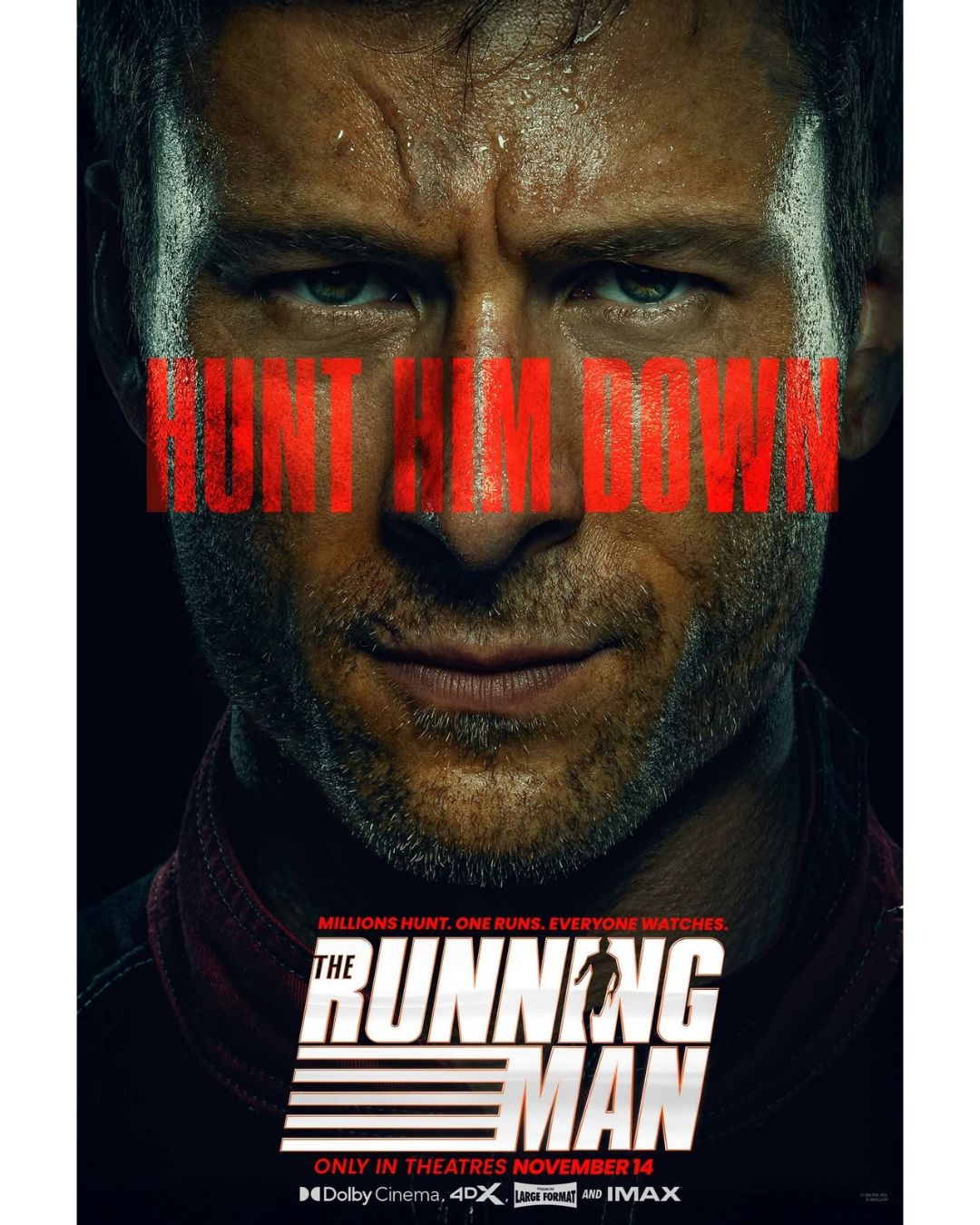
The Running Man

Does America harbor a sadistic society? Are stunt-based TV competitions a last refuge for the desperate? Is “reality” TV real or is it faked? How close are we to a dystopian police state? 

These are legitimate questions one might ask after seeing the new film The Running Man. But if you want to ENJOY the movie, it’s best to table those questions for now and let the almost non-stop action take you along on Ben Richards’s quest for survival. It’s a fun ride with new challenges for The Running Man popping up constantly.

Richards (Glen Powell) is a husband and father whose baby daughter needs meds. He can’t keep a job and keeps getting fired for insubordination. His wife Sheila (Jayme Lawson) works at a strip joint as a waitress. Richards goes to network studios to pursue a spot on a game show and ends up as one of three contestants on The Running Man. The odds that he will survive the hunters who chase him are small but the potential reward is a huge pile of money. 

The film is a revised remake of the 1987 film The Running Man which starred Arnold Schwarzenegger as Richards and Richard Dawson as Damian Killian, the producer and host of the TV show. The new film stars Josh Brolin as producer Dan Killian and Colman Domingo as Bobby, the show’s host. The prize money is in “new dollars” and the currency shown has Schwarzenegger’s photo on it!

Richards’s journey takes him from the dystopian city where he lives to New Hampshire and Maine. The tale is from a book by Bangor resident Stephen King, originally published under the nom de plume Richard Bachman.

Before he hits the road he gets disguises and fake IDs from a crafty anarchist played by the always excellent Willam H. Macy.

In a beautiful old New England home Richards is given refuge by Elton, a strange man played by Micheal Cera whose crazed mother (Sandra Dickinson) ID’s Richards and calls in the Hunters to take him in. For Cera, this is his second odd ball role this year, following his appearance in The Phoenician Scheme back in the spring. 

Richards escapes, ending up in a highway chase, riding with a young woman Amelia (Emilia Jones) before boarding an airplane where he faces off with a prior Running Man contestant Evan McCone (Lee Pace) on his way to the story’s conclusion.

The action is intense and the story moves fast. The movie isn’t exactly one long chase scene but Richards has to stay on the move. A one word review of The Running Man might be “kinetic.” As mentioned, it’s a fun film and Glen Powell is up to the task of carrying it to the finish line. Enjoy it with the large bucket of popcorn.

The Running Man is directed by Edgar Wright, written by Wright and Michael Bacall. Rated R.

Nuremberg

Nuremberg. Powerful drama. Excellent film!

You’d be correct to presume that the two lead actors would deliver knockout performances in this new movie. Hermann Goring (Russell Crowe) and U.S. Army shrink Douglas Kelley (Rami Malek) have a compelling relationship before, during and after the trial of the highest ranking surviving Nazi and several of his henchmen.

A surprise is Michael Shannon’s acting. He plays U.S. Supreme Court Justice Robert Jackson. Shannon’s a solid actor but his work here is a few notches above his normal level. It’s a juicy role for him and he brings it home.

Goring is captured after the war has ended. Should the allies just shoot him and move on? Justice Jackson suggests an international tribunal would allow the world to know the details of the German’s horrific acts. Jackson meets the pope to seek the pontiff’s sanction for such a trial. He becomes the lead prosecutor.

Yes, Nuremberg is a courtroom drama. But much of the film’s narrative occurs outside the courtroom. Kelley meets newswoman Lila (Lydia Peckham) on his train ride to Nuremberg. Her appearance later in the film leads to a key development.

Kelley is assigned to evaluate the Nazis as they await trial. His conversations with Goring lead him to have a level of respect—almost an admiration—for the Nazi murderer. He even serves as a go-between, taking missives from Goring to his wife.

Kelley is joined along the way by Dr. Gustav Gilbert (Colin Hanks) who tries to provide input and assistance to Kelley but they clash. Prosecution teammate Brit Sir David Maxwell-Fyfe (Richard E. Grant) helps justice Jackson in his courtroom face-off with Goring. Kelley’s translator Howie Triest (Leo Woodall) adds an important viewpoint.

Nuremberg has several scenes of the Nazi death camps, offering visual evidence of the mass killings of Jews, showing piles of human bodies and evidence of abuse of those still alive. Even if you’ve seen some of these images before, their effect is still gut wrenching eighty years later. Obviously this film montage of Nazi terror was a vital element of the case that led to the conviction and sentencing of Goring and his associates.

James Valentine wrote and directed Nuremberg. He does a nice job of balancing all the story’s parts and not getting bogged down in its focus on Goring or on the drama inside the courtroom. Bravo, Mr. Valentine!

There are those who will (and have already) compare what happened in Nazi Germany to our recent political history in the United States. But equating a president who works to consolidate executive power and punish his political enemies with a regime that slaughtered six million humans is ridiculous. 

Could what happened in Germany a century ago happen here? Could it happen anywhere? Is our species prone to evil behavior if unchecked? Is there a lesson for the world from the Nuremberg trial? Yes. This new film reiterates that lesson and reminds us of what happened then and should never be forgotten.

Nuremberg is rated R. It runs just under two-and-a-half hours.

A Big Bold Beautiful Journey

It’s a shame, really. To have two attractive, talented actors like Margot Robbie and Colin Farrell and deliver this mess of a movie.

I like fantasy and I appreciate quirky elements in films, but A Big Bold Beautiful Journey is a boring, tedious effort. It is glacially slow and features dialogue that might make you want to change the channel. Which is hard to do in a movie theater.

David (Farrell) and Sarah (Robbie) meet at a wedding, chat a bit, run into each other at Burger King and then begin their journey. They ride in a rented 1994 Saturn, equipped with a sentient GPS that guides them to various stops. (Phoebe Waller-Bridge is the woman at the bizarre car rental agency who insists he take the GPS.)

Most of the stops are connected to David and Sarah’s past lives. At his high school, David butts in on the production of a stage musical. The two travelers visit with their former lovers at a restaurant and, before they move on, all four are chatting at the same table. 

David later visits with his father as he awaits news of the birth of his son (David). He spends a moment with his younger self in his old bedroom. And Sarah travels back in time to visit with her deceased mother, supposedly to make amends for not having been present when mom died. She relives the memory of watching Big with her mother.

Throughout the movie, each flashback episode begins with the opening of a door. And then at the end of the movie, a cover version of the Who’s song Let My Love Open The Door is played. That’s cute.

Should the director Kogonada and scriptwriter Seth Reiss be given credit for attempting to persuade moviegoers to buy into their fantasy? Well, maybe. The film does have a few nice visuals. And the two lead characters are likable despite their often clunky dialogue.

A Big Bold Beautiful Journey lays a big egg, in my opinion. Would I have liked this movie if I were younger? Maybe. But not necessarily. A Big Bold Beautiful Journey is rated R for language. No sex, no nudity.

Materialists

Tell me what you’re looking for in a ROM-COM. Let’s see if we can find a match! Romance? Comedy? Yes, of course. Those are non-negotiables!

Attractive stars playing cool characters? How about Dakota Johnson, Pedro Pescal and Chris Evans? (As Lucy, a professional matchmaker;  Harry, a financier; and John, a struggling actor, respectively.)

A “meet cute”? For sure. At a wedding reception, no less!

A reunion with a lost love? Yep! At that same wedding reception.

A damsel in distress? Well, one of Lucy’s clients, Sophie (Zoe Winters.)

A clever script with memorable declarations and observations about love and dating and marriage and money? We may have a match here!

Are you willing to overlook a horrible title and occasionally slow pacing? Materialists? Really? Couldn’t writer/director Celine Song have come up with a catchier title for her movie than that? Hey, you can’t have everything!

Surprises? Shhhhh! No spoilers!

Sexual content? A smidge. No nudity. Mostly post-coital chat and some F-bombs. Ergo, an R rating.

Seriously, Materialists is several notches above the average ROM-COM. 

The film has fun presenting a few of the candidates for matchmaking and their very specific qualifications about whom they’d consider for dating. 

Dakota Johnson is excellent as a 30-something woman who is smart and successful in her work matching up couples but has low self esteem regarding her own value as a mate.

The characters that Pascal and Evans portray are both honorable, likable men. Neither is the “bad guy” or the less-than-adequate guy who often appears in ROM-COMs to add to the tension.

Would Materialists be a good date film? I say yes. It would likely generate conversation for couples who are either casually dating or getting serious. 

The final shot of Materialists is pure genius. It comes as the end credits roll and the new Japanese Breakfast theme song My Baby (Got Nothing At All) plays. Followed by the hilarious John Prine and Iris DeMent duet In Spite of Ourselves.

Materialists runs just under two hours.

From the World of John Wick: Ballerina

From the World of John Wick: Ballerina is NOT a John Wick movie. Although John Wick (Keanu Reeves) makes his presence known at a key moment of the movie. And while there’s a bit of ballet dancing, there’s not much.

FTWOJW:B is the story of Eve Macarro (Ana de Armas) who, as a young girl, sees her father killed by an assassin. She vows revenge. Under the tutelage of The Director (Angelica Houston), Eve learns to dance and to battle.

As observed with John Wick films, the face-to-face, often hand-to-hand, combat is staged at times much like a ballet. The film’s pace is relentless and so is the cracking of skulls and other body parts. Eve’s battles involve strong physical skills and a variety of weapons including firearms and knives. Even a flamethrower! 

Eve’s goal of avenging her father’s death runs counter to the sort of detente between the Roma Ruska sect and the group led by the Chancellor (Gabriel Byrne). The Director (that is, Houston’s character, not Len Wiseman, the film’s director) tells her to cool it but she does not relent. She takes her revenge mission to a lovely European village where she encounters a knife wielding barista. And has a tense confrontation with The Chancellor.

Armas may be the most beautiful woman to be involved in the nasty business of violence and killing. She employs her skills well and appears to take as much, maybe even more, physical abuse than does Wick himself in his four films. And she knows how to handle a flame thrower!

Also appearing in FTWOJW:B are Wick regulars Ian McShane as Winston and, in his final film appearance, Lance Riddick as Charon. Norman Reedus of Walking Dead fame is introduced as Daniel Pine, a man who, like Eve’s father, hopes to keep his young daughter away from all the nastiness. Could he appear in any future Ballerina films? 

From The World of John Wick: Ballerina is rated R and runs just over two hours but it seems shorter because it moves so quickly. If you could use a good action movie, don’t miss it!

Novocaine

Jack Quaid has a problem. Or is it I who has the problem?

His highly entertaining new action/adventure film Novocaine is well-crafted and Quaid’s character is developed a bit more than is typical in movies like this one.

But throughout the screening of Novocaine almost every time Quaid appeared onscreen I saw… Bill Hader. They have similar builds, similar hairlines and even some similar facial expressions. Does anybody else have the Hader issue with Quaid or is it just me?

The movie is a treat for fans of violence, chases, gunplay, hand-to-hand combat and all that sort of stuff. It’s a real adrenaline rush. And there are laughs along the way, too.

Nathan Caine (Quaid) is a guy with weird genetic disorder: he cannot feel pain. This has led to some behavioral quirks. He won’t even eat solid food for fear of chewing off his tongue and not feeling it. His only friend is a fellow gamer Roscoe (Jacob Batalon), a guy he’s never actually met except online. 

Nate hooks up with a coworker Sherry (Amber Midthunder) who also has issues from a dysfunctional upbringing. They work at a bank in San Diego where Nate is assistant manager. Novocaine starts out as a sweet romcom.

Then a robbery occurs. The bank manager is killed. Several cops are gunned down. Sherry is taken as a hostage. Nate heads off in pursuit to rescue her—in a police car.

His effort takes him to a commercial kitchen with hot grease and a hot frying pan, a house filled with booby traps and a tattoo parlor where Nate takes on a tattoo artist who is a mountain of a man.

Co-directors Dan Berk and Robert Olsen and writer Lars Jacobson keep the momentum going from the robbery to the final face off on the San Diego docks. The work done by the film’s stunt coordinators is impressive.

Hader—um, sorry, Quaid—is good at comedy AND violence and at mixing the two in the same scene. Batalon’s first onscreen appearance late in the movie is a key element in the plot. And Midthunder is revealed to have abilities beyond being just a sweet, demure young babe.

Among the supporting players are familiar faces Matt Walsh and Betty Gabriel as San Diego cops. 

Novocaine is rated R.

A Real Pain

A Real Pain is a sweet little movie about two cousins who travel to Poland together via funding from their late grandmother. On the trip they explore grandma’s homeland, their Jewishness and their relationships with one another.

David is played by Jesse Eisenberg who wrote and directed the film. He’s the straight arrow, married with a kid, working in marketing in NYC. He has anxiety but controls it with meds.

Cousin Benji is the title character, played by Kieran Culkin. He’s a mess. One might easily conclude that he is “on the spectrum,” based on his erratic behavior and his responses to certain elements of their trek.

Shortly after they arrive in Warsaw, they meet up with their entourage including recent divorcee Marcia (Jennifer Grey!) who Benji pals up with, though not in a romantic way. There’s also an older couple from Cleveland. And, interestingly, a black man from Wisconsin, who escaped genocide in his native African land and became interested in Judaism from a support group in the U.S.

The tour leader is an Englishman who narrates the group’s visits to a war memorial, a cemetery and a concentration camp. David and Benji break off from the group to see the place where grandma lived.

The film’s soundtrack is primarily Chopin piano pieces which, like anything that’s overdone, become tedious after a while. Of course, it’s entirely appropriate to use his music as he is a Polish icon. Heck, the Warsaw airport is named for him!

Benji lives in Binghamton so he and David haven’t spent much time together recently. Their interactions with each another and with the travel group are often uncomfortable as the cousins revisit their family histories and try to understand each other’s current life situations.

For fans of Kieran Culkin’s work on the recent series Succession, A Real Pain is a must-see. His performance is the spice that gives the story some necessary conflict and helps showcase his range as an actor. Some folks have suggested that his work here may even be award-worthy. TBD.

A Real Pain clocks in at just under 90 minutes. It is rated R for language and drug use, mainly weed. 

It Ends With Us

It Ends With Us, the new film adapted from Colleen Hoover’s 2016 best selling novel, is a cautionary tale. For some, it may even be instructive.

The “it” in the title is the cycle of spousal abuse which sometimes continues through generations. The movie does have many light moments and some semi-steamy romance but there’s also a dark undercurrent. 

Lily Bloom (Blake Lively) is a thirtysomething Bostonian who returns home to Maine after her father’s death. At his funeral when she is asked to say a few words about him, she has nothing. Why? It is soon revealed that her father was physically abusive to her mom.

Lily meets Ryle Kincaid (Justin Baldoni) a Boston surgeon and a slowly simmering romance ensues. Lily gets signs that Ryle has a temper. In fact the first thing she sees him do is kick a chair in anger. 

Lily opens a flower shop and her first employee Allyssa (Jenny Slate) just happens to be Ryle’s sister who shares insight into her brother’s behavior.

Meanwhile, Lily’s old boyfriend from her hometown Atlas (Brandon Sklenar) reappears in her life when she and Ryle dine in his (Atlas’s) new restaurant. When Lily shows up later at Atlas’s joint with a bit of a shiner, the result of an overreaction by Ryle to a kitchen disaster, Atlas confronts Ryle. When Ryle later discovers that Atlas has given her his phone number in case of trouble, he gets upset again.

Lily has flashbacks to life back in Maine and the tension in her household. She also recalls her early times with Atlas. Young Lily (Isabela Ferrer) and young Atlas (Alex Neustaedter) also experience her dad’s volatile temper.

It Ends With Us maintains a simmering level of tension from start to finish. Lily’s mom tells her daughter that she loved her husband despite his abuse. Lily offers Ryle forgiveness for his transgressions. But how far will that go? What role will Atlas play in her encounters with him now that they are both adults? 

Blake Lively carries the film in a role that has her portrayal of Lily cover a spectrum of character types ranging from a sexy babe to a hustling business owner to an assertive woman who takes control of her life. She’s good!

Coleen Hoover has said that the story is based on the relationship of her mother and father. And that it was hard for her to write. Its success has spawned a sequel book and helped make Hoover a fan favorite.

A best-selling novel that generates a lot conversation should deliver a built-in audience for the film version. But since more people see movies than read books, the word-of-mouth opinions from early movie goers will determine if It Ends With Us has legs. I’m guessing it will. 

Rated R. Directed by the guy who plays Ryle, Justin Baldoni.

American Fiction

American Fiction is a brilliant film about racial hypocrisy and the people—both white and black—who exploit it. Be ready to laugh. Some of the satire is over the top but much of it is not that far from reality.

American Fiction is also a story about a family in transition… a family that happens to be black. They are dealing with death, divorce, dementia, economic concerns, new romance, promiscuity, etc. Things that many families confront. Be ready to cry.

American Fiction has a talented cast, led by Jeffrey Wright as writer/teacher Thelonius “Monk” Ellison. Tracee Ellis Ross and Sterling K. Brown are his siblings. Leslie Uggams is his mother. Erika Alexander is his new girlfriend. Issa Rae is a Sintara Golden, a writer whose work elicits a strong response from Monk. Wright is nominated for a Golden Globe and a possible Oscar nomination may be still to come for Wright (and for other cast members, too). Be ready to applaud.

After being placed on leave from his university teaching position for offending a student’s sensibilities, Monk returns home to Boston to visit his family. He attends a conference where he observes Golden’s “authentic” black voice being hailed by a mostly white audience. He responds by anonymously writing a ridiculous book about his imagined experiences as a beaten-down black man. The book becomes a critical and financial hit and wins a big award.

Meanwhile, Monk finds new love with beach house neighbor Coraline (Erika Alexander) and addresses his mother’s descent into dementia. 

Cord Jefferson, who wrote the script and directed, could be an Oscar nominee for best adapted screenplay. He would be a long shot to get a director nod from the Academy. Not just because he is a first-time director but also because competition in that category is strong this awards season. In case you’re wondering, Jefferson is a mixed-race man. 

American Fiction is a likely nominee for Best Picture. It is a film that entertains and may trigger a response or two you were not expecting. Does the film have a “message?” That depends, I think, on your own life experiences.

In one of the film’s scenes, Monk goes into a book store and sees his previously written books included in the black authors section. He tells the store clerk that his books are not “black” books per se and should be included in the general inventory. Similarly, I would suggest that, while some may see this as a “black” movie since it has a mostly black cast, American Fiction is not just for black audiences. It’s for everybody.

 It is clever and different. American Fiction is a must-see! (Rated R.)