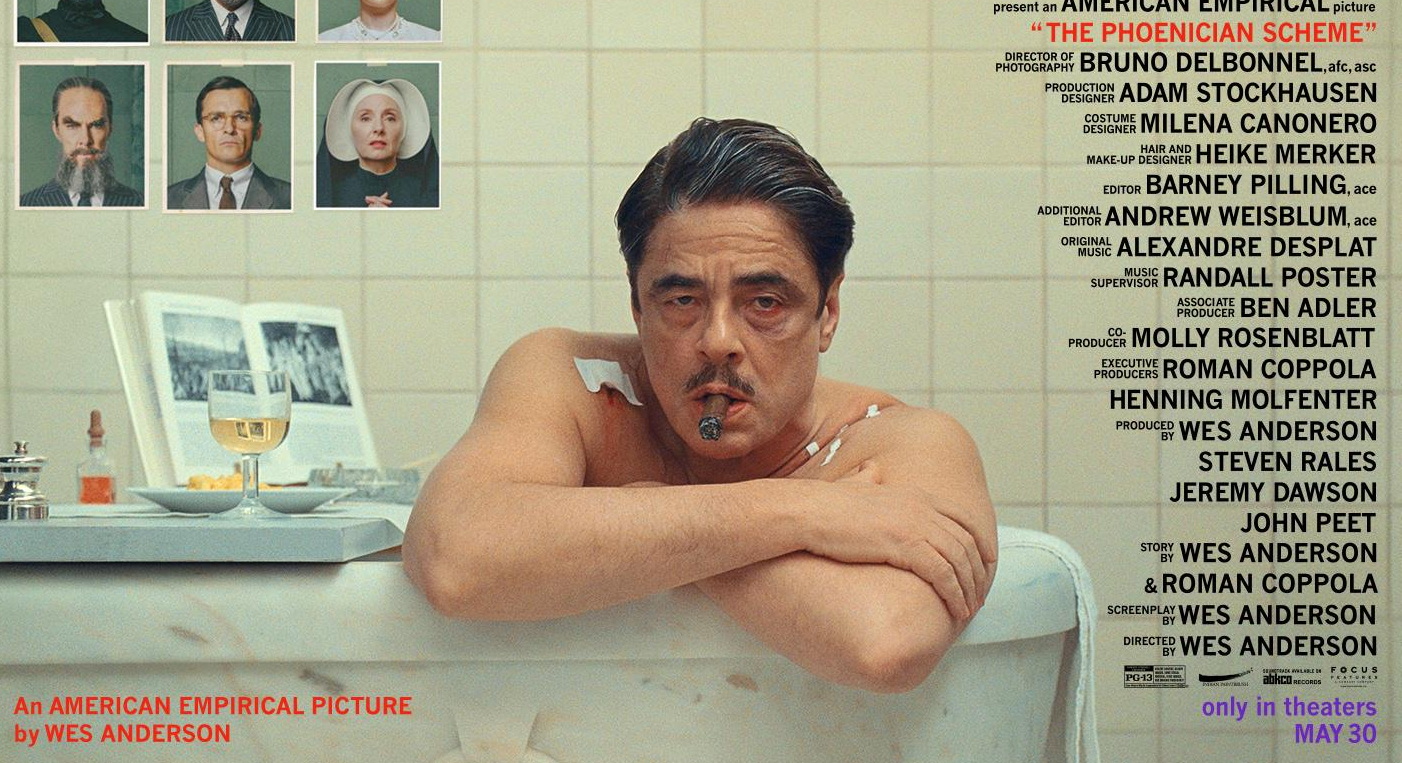
Director Wes Anderson dazzles with his zany new movie The Phoenician Scheme. A gaggle of wacky characters zigzag through episodes that are not always laugh-out-loud funny but are consistently bizarre, surprising, compelling and reassuring.
Reassuring, that is, that Anderson can still make a fun film. After his recent lackluster efforts, concern that he may have lost his touch can be put aside for at least one hour and forty-five minutes as Anderson pulls out some of his trademark tricks—overhead shots, tracking shots, maps, oddly titled books etc.—and introduces a few new ones.
As is his habit, the director employs a large cast of his favorites including Tom Hanks, Bryan Cranston, Jeffrey Wright, Scarlett Johansson, Benedict Cumberbatch, Willem Dafoe and, in a brief appearance in a dream sequence as God, Bill Murray.
This time Anderson puts most of his eggs into one cinematic basket by making Benicio Del Toro the main star who does much of the film’s heavy lifting. He plays Zsa-Zsa Korda, a businessman who has many enemies, some of whom, he claims, are trying to assassinate him. Del Toro’s voice sounds, to my ear, almost exactly like Clark Gable’s.
Korda keeps his business matters in shoeboxes. (Hey, the film is set in the middle of the last century when people DID keep important papers and stuff in shoeboxes. And cigar boxes. Etc.)
Also receiving an abundance of screen time is Mia Threapleton. Who? She’s the daughter of Kate Winslet and filmmaker Jim Threapleton. She plays Korda’s daughter, Liesl, who is a nun but who also wears red lipstick and heavy eye shadow.
Korda also has nine sons who mostly stay out of sight and occasionally launch arrows down at Korda from the balcony above his table. What? Silly stuff, that’s what.
Bjorn (Michael Cera) is Korda’s assistant, who is charged with keeping control of a red satchel containing all of Korda’s liquid funds, but who frequently misplaces it.
The plot involves Korda’s lining up an assortment of individuals to get them to buy into his scheme, um, plan to fund a large infrastructure project in Phoenicia. The script is by Anderson from a story he concocted with frequent collaborator Roman Coppola.
Any recommendation of The Phoenician Scheme must be prefaced with the words “if you like Wes Anderson movies.” He has made some good and clever ones such as The Royal Tenenbaums and The Grand Budapest Hotel. If you have enjoyed either or both of those, you may find The Phoenician Scheme to your liking.
This is a film I would’ve enthusiastically embraced when I was in high school and college. Because I still maintain a certain level of immaturity, The Phoenician Scheme is goofy enough and silly enough to tap into that part of me that goes for the nonsensical.
I also appreciate the fact that the film’s credits include the names of the housekeeping staff at the hotel where the cast and crew stayed during its production last year in Germany.
The Phoenician Scheme runs an hour and forty-five minutes. Rated PG-13.
 David Craig Movies