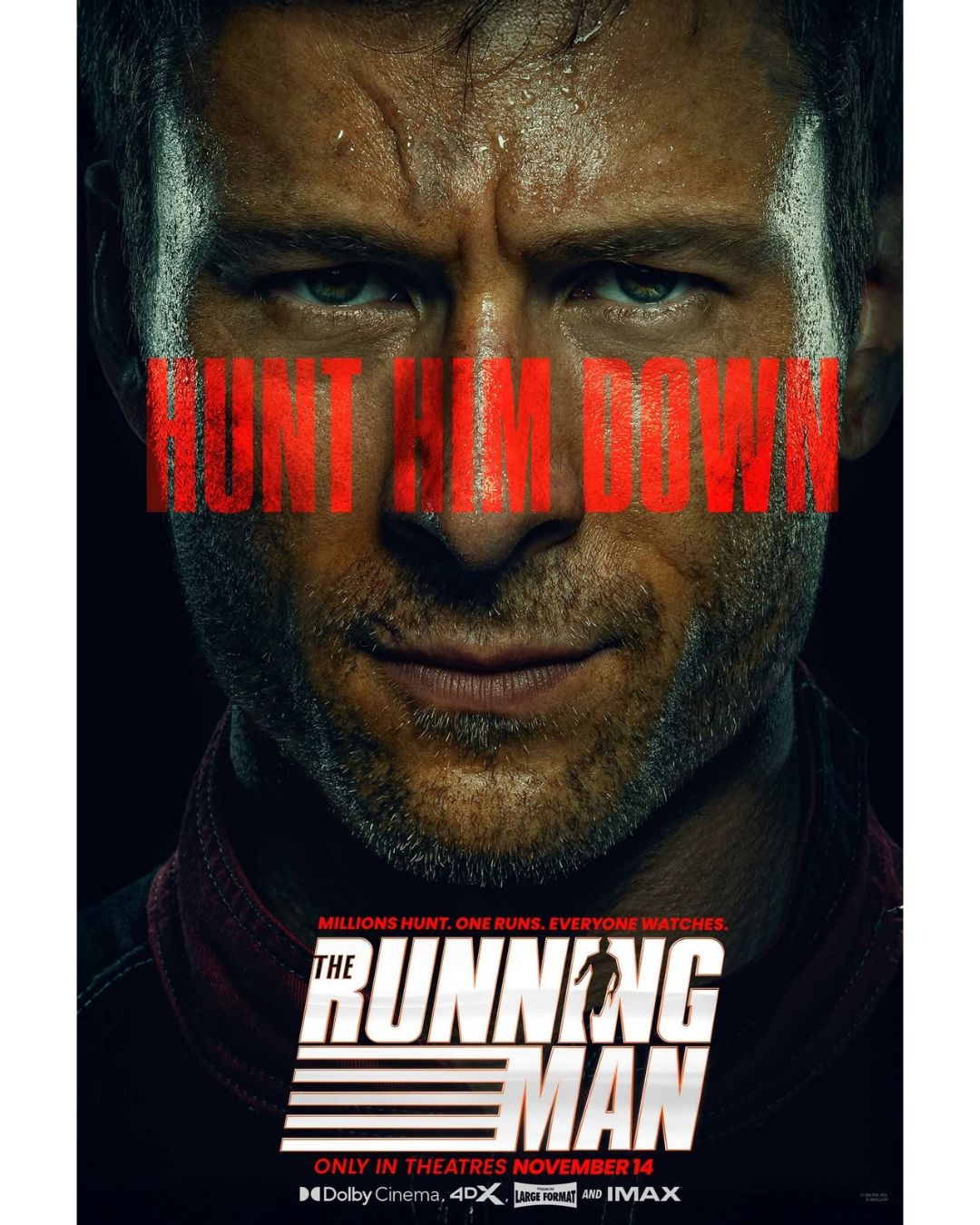
The Running Man

Does America harbor a sadistic society? Are stunt-based TV competitions a last refuge for the desperate? Is “reality” TV real or is it faked? How close are we to a dystopian police state? 

These are legitimate questions one might ask after seeing the new film The Running Man. But if you want to ENJOY the movie, it’s best to table those questions for now and let the almost non-stop action take you along on Ben Richards’s quest for survival. It’s a fun ride with new challenges for The Running Man popping up constantly.

Richards (Glen Powell) is a husband and father whose baby daughter needs meds. He can’t keep a job and keeps getting fired for insubordination. His wife Sheila (Jayme Lawson) works at a strip joint as a waitress. Richards goes to network studios to pursue a spot on a game show and ends up as one of three contestants on The Running Man. The odds that he will survive the hunters who chase him are small but the potential reward is a huge pile of money. 

The film is a revised remake of the 1987 film The Running Man which starred Arnold Schwarzenegger as Richards and Richard Dawson as Damian Killian, the producer and host of the TV show. The new film stars Josh Brolin as producer Dan Killian and Colman Domingo as Bobby, the show’s host. The prize money is in “new dollars” and the currency shown has Schwarzenegger’s photo on it!

Richards’s journey takes him from the dystopian city where he lives to New Hampshire and Maine. The tale is from a book by Bangor resident Stephen King, originally published under the nom de plume Richard Bachman.

Before he hits the road he gets disguises and fake IDs from a crafty anarchist played by the always excellent Willam H. Macy.

In a beautiful old New England home Richards is given refuge by Elton, a strange man played by Micheal Cera whose crazed mother (Sandra Dickinson) ID’s Richards and calls in the Hunters to take him in. For Cera, this is his second odd ball role this year, following his appearance in The Phoenician Scheme back in the spring. 

Richards escapes, ending up in a highway chase, riding with a young woman Amelia (Emilia Jones) before boarding an airplane where he faces off with a prior Running Man contestant Evan McCone (Lee Pace) on his way to the story’s conclusion.

The action is intense and the story moves fast. The movie isn’t exactly one long chase scene but Richards has to stay on the move. A one word review of The Running Man might be “kinetic.” As mentioned, it’s a fun film and Glen Powell is up to the task of carrying it to the finish line. Enjoy it with the large bucket of popcorn.

The Running Man is directed by Edgar Wright, written by Wright and Michael Bacall. Rated R.

Pet Sematary

Pet-Sematary-1

That delicious discomfort that drives us to watch scary movies! Hey, it’s a Stephen King story. Which means Pet Sematary has plenty of creepy elements to make an audience tingle with uneasiness.

Weird noises. Flickering lights. Doors that shouldn’t be opened but are opened anyway. Haunting flashbacks. A gory injury. A mysterious neighbor. And the discovery that a new home is nearby to a pet cemetery with a misspelled sign.

As with the recent film Us, a family unit of mom, dad, daughter and son pulls into a new house where all seems idyllic. Also, as in Us, the mom has dark memories of a frightening episode of her life.

Louis (Jason Clarke) and Rachel (Amy Seimetz) are parents to Ellie (Jeté Laurence) and Gage (Hugo and Louie Lavoie). The crusty neighbor is Jud (John Lithgow).

The new home is on the edge of the woods, on the edge of a small town in Maine. In short order, Ellie takes a walk into the woods to check out the pet cemetery and the strange wall of tree branches where she has her first encounter with Jud.

When the family’s cat dies, Jud leads Louis to a burial ground beyond that wall. The cat’s interment sets off the events that lead to some grisly outcomes.

Does Pet Sematary break new ground in filmmaking? No. But co-directors Kevin Kolsch and Dennis Widmyer have constructed an entertaining 100 or so minutes of scary, suspenseful storytelling. And it’s always fun to see John Lithgow onscreen.

Don’t expect a revelation. Or a classic. But the newest version of this Pet Sematary, sourced from Stephen King’s book, is good, creepy fun.


A Walk In The Woods


Ever since I read Edward Garvey’s 1972 book about his Appalachian Trail thru-hike several decades ago, I’ve fantasized about hiking the AT. But a thru-hike, from Georgia to Maine, requires a huge chunk of time away from work and family.

Last year’s Wild, which chronicled Cheryl Strayed’s trek on the Pacific Crest Trail, provided vicarious thrills, but that tale was more about a woman’s self-discovery than about her actual hike.

The new film A Walk In The Woods satisfies outdoor adventure desires on many levels, but disappoints on others. Based on the book by humorist/memoirist Bill Bryson, the story walks a fine line (pun intended) between serious quest and chucklefest.

Sadly, the main flaw of A Walk In The Woods is the casting of Robert Redford in the lead role as Bryson. Not because he’s too old for the role (though he probably is), but because he seems to be phoning in his performance. Did he only do the movie to placate his fellow producers?

Happily, the casting of Nick Nolte as Bryson’s long ago acquaintance from Des Moines, Stephen Katz, is a masterful choice. Nolte plays an unkempt recovering alcoholic whose life hasn’t worked out as nicely as Bryson’s. Emma Thompson appears as Mrs. Bryson, playing the role she often plays—a not particularly likable, very British woman.

Bryson’s idea for the expedition, as depicted in the movie, seems like a sudden random urge. (Whereas you or I might give such an undertaking a bit more consideration.)

After a trip to REI for gear (where Nick Offerman makes a so-quick-if-you-blink-you’ll-miss-it appearance as a clerk), this odd couple shoves off from the AT’s start point in Georgia. Episodes along the way include encounters with annoying solo hiker Mary Ellen (Kristen Schaal), a pair of fierce looking bears, a surprise snowstorm and a flirty off-trail motel operator (Mary Steenburgen).

After each episode, Katz tells Bryson, “You’ve got to put that in the book.” Bryson keeps saying he’s not going to write a book about the hike. (Of course, he did.)

Director Ken Kwapis (a man with a deep movie and TV resumé) has crafted a film that’s beautiful to look at and generally enjoyable. I would’ve liked to see more of their story, but 1:44 is long enough for most folks. The film is rated R for language, but is not particularly offensive.

A Walk In The Woods is expected to generate increased hiker traffic on the AT, just as Wild has done for the PCT. My personal desire to hike the full Appalachian Trail will have to wait until my next lifetime, but I’ll be thinking of Bryson and Katz the next time I ascend the bluff at Castlewood Park or traipse through the meadow at Queeny Park.

Hope Springs

This is a movie for older grownups. The advance screening was sponsored by AARP. Stars Meryl Streep and Tommy Lee Jones are on the cover of the August AARP magazine.

Can someone under 50 relate to a married couple that hasn’t had sex in over four years? I’m not sure whether many married couples OVER 50 can relate to such celibacy. But that issue is part of the problem that sets the plot of “Hope Springs” in motion.

Meryl is Kay. Tommy Lee is Arnold. They are a middle-class couple from Omaha who have been married 31 years. She picks up a self-help book by a marriage counselor and drags Arnold along to a small town in Maine called “Great Hope Springs” for a week-long session with the author. The counselor is Steve Carrell in a (mostly) non-comedic role.

“Hope Springs” is funny and poignant. The highlights of the film are Tommy Lee Jones’ hilarious facial expressions and a classic scene in a movie house, which I will not spoil by revealing details.

Of course, Meryl Streep’s acting skill is a given. Since she is playing an ordinary housewife, it may seem that she’s not working as hard as, say, when she’s playing Maggie Thatcher or Julia Child. No matter how hard she may or may not be working, her screen presence shows why she’s one of the giants of acting.

The TV spots make “Hope Springs” look like a laugh fest and, while there are some good yuks, this is a movie that reveals the problems many couples (of all ages) have communicating. While the four-year whoopie drought may seem extreme to many of us, there are issues in Kay and Arnold’s marriage that all long-married couples can identify with.

“Hope Springs” is rated PG-13 but addresses sexual issues that may make certain audience members squirm, just like they make Kay and Arnold squirm.

“Hope Springs” is not just for the over 50 crowd, but if you are beyond that milestone—especially if you’ve been married a few decades—this one’s for you.