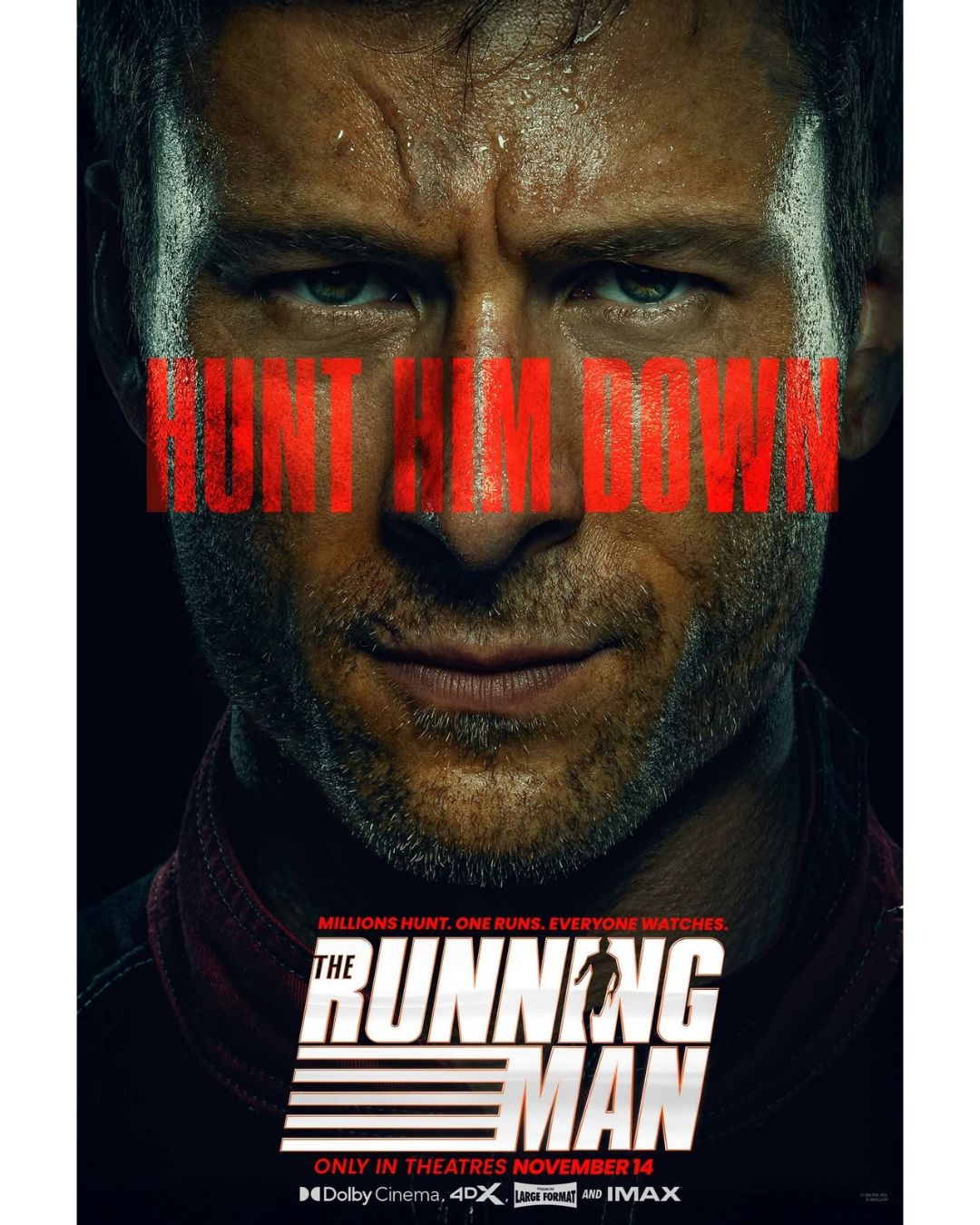
Does America harbor a sadistic society? Are stunt-based TV competitions a last refuge for the desperate? Is “reality” TV real or is it faked? How close are we to a dystopian police state?
These are legitimate questions one might ask after seeing the new film The Running Man. But if you want to ENJOY the movie, it’s best to table those questions for now and let the almost non-stop action take you along on Ben Richards’s quest for survival. It’s a fun ride with new challenges for The Running Man popping up constantly.
Richards (Glen Powell) is a husband and father whose baby daughter needs meds. He can’t keep a job and keeps getting fired for insubordination. His wife Sheila (Jayme Lawson) works at a strip joint as a waitress. Richards goes to network studios to pursue a spot on a game show and ends up as one of three contestants on The Running Man. The odds that he will survive the hunters who chase him are small but the potential reward is a huge pile of money.
The film is a revised remake of the 1987 film The Running Man which starred Arnold Schwarzenegger as Richards and Richard Dawson as Damian Killian, the producer and host of the TV show. The new film stars Josh Brolin as producer Dan Killian and Colman Domingo as Bobby, the show’s host. The prize money is in “new dollars” and the currency shown has Schwarzenegger’s photo on it!
Richards’s journey takes him from the dystopian city where he lives to New Hampshire and Maine. The tale is from a book by Bangor resident Stephen King, originally published under the nom de plume Richard Bachman.
Before he hits the road he gets disguises and fake IDs from a crafty anarchist played by the always excellent Willam H. Macy.
In a beautiful old New England home Richards is given refuge by Elton, a strange man played by Micheal Cera whose crazed mother (Sandra Dickinson) ID’s Richards and calls in the Hunters to take him in. For Cera, this is his second odd ball role this year, following his appearance in The Phoenician Scheme back in the spring.
Richards escapes, ending up in a highway chase, riding with a young woman Amelia (Emilia Jones) before boarding an airplane where he faces off with a prior Running Man contestant Evan McCone (Lee Pace) on his way to the story’s conclusion.
The action is intense and the story moves fast. The movie isn’t exactly one long chase scene but Richards has to stay on the move. A one word review of The Running Man might be “kinetic.” As mentioned, it’s a fun film and Glen Powell is up to the task of carrying it to the finish line. Enjoy it with the large bucket of popcorn.
The Running Man is directed by Edgar Wright, written by Wright and Michael Bacall. Rated R.

 David Craig Movies