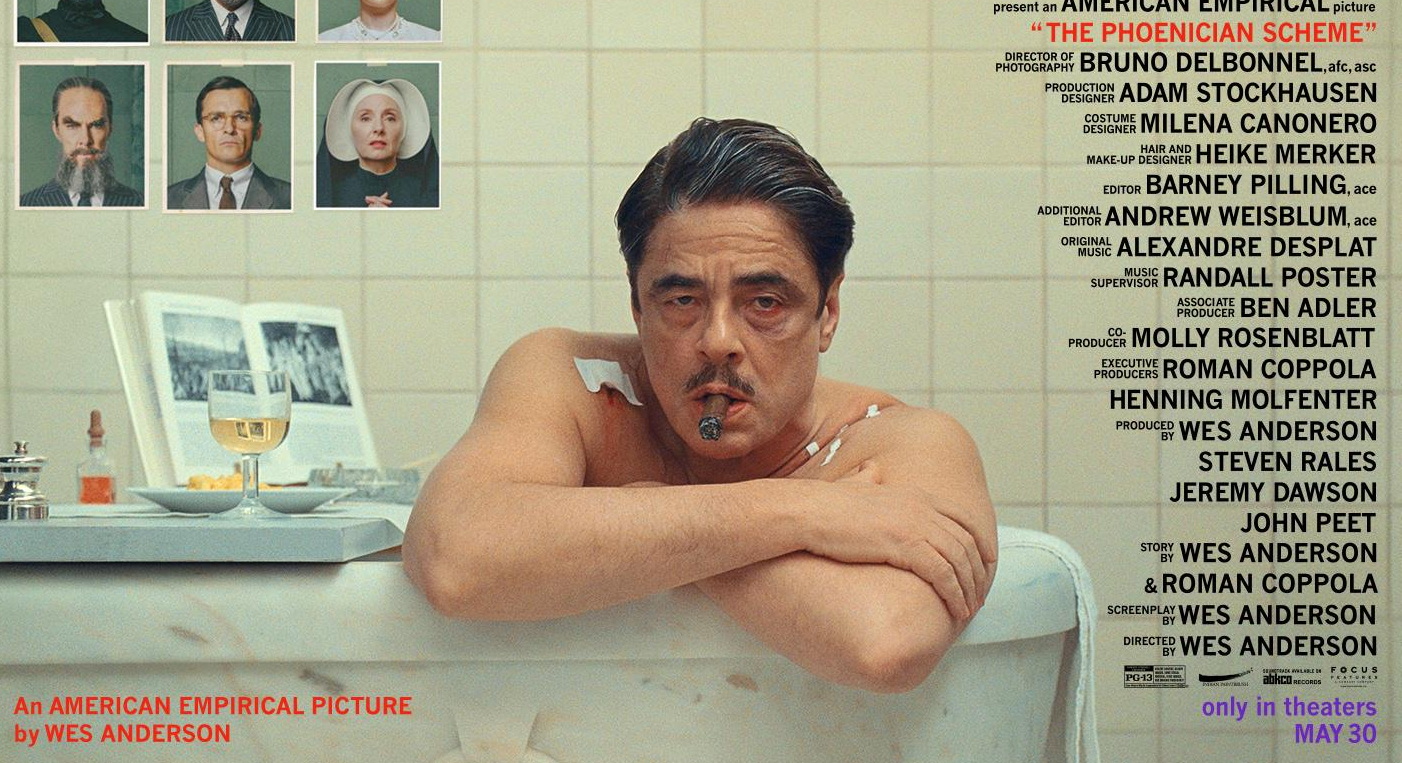
The Phoenician Scheme

Director Wes Anderson dazzles with his zany new movie The Phoenician Scheme. A gaggle of wacky characters zigzag through episodes that are not always laugh-out-loud funny but are consistently bizarre, surprising, compelling and reassuring.

Reassuring, that is, that Anderson can still make a fun film. After his recent lackluster efforts, concern that he may have lost his touch can be put aside for at least one hour and forty-five minutes as Anderson pulls out some of his trademark tricks—overhead shots, tracking shots, maps, oddly titled books etc.—and introduces a few new ones. 

As is his habit, the director employs a large cast of his favorites including Tom Hanks, Bryan Cranston, Jeffrey Wright, Scarlett Johansson, Benedict Cumberbatch, Willem Dafoe and, in a brief appearance in a dream sequence as God, Bill Murray.

This time Anderson puts most of his eggs into one cinematic basket by making Benicio Del Toro the main star who does much of the film’s heavy lifting. He plays Zsa-Zsa Korda, a businessman who has many enemies, some of whom, he claims, are trying to assassinate him. Del Toro’s voice sounds, to my ear, almost exactly like Clark Gable’s.

Korda keeps his business matters in shoeboxes. (Hey, the film is set in the middle of the last century when people DID keep important papers and stuff in shoeboxes. And cigar boxes. Etc.) 

Also receiving an abundance of screen time is Mia Threapleton. Who? She’s the daughter of Kate Winslet and filmmaker Jim Threapleton. She plays Korda’s daughter, Liesl, who is a nun but who also wears red lipstick and heavy eye shadow.  

Korda also has nine sons who mostly stay out of sight and occasionally launch arrows down at Korda from the balcony above his table. What? Silly stuff, that’s what.

Bjorn (Michael Cera) is Korda’s assistant, who is charged with keeping control of a red satchel containing all of Korda’s liquid funds, but who frequently misplaces it.

The plot involves Korda’s lining up an assortment of individuals to get them to buy into his scheme, um, plan to fund a large infrastructure project in Phoenicia. The script is by Anderson from a story he concocted with frequent collaborator Roman Coppola.

Any recommendation of The Phoenician Scheme must be prefaced with the words “if you like Wes Anderson movies.” He has made some good and clever ones such as The Royal Tenenbaums and The Grand Budapest Hotel. If you have enjoyed either or both of those, you may find The Phoenician Scheme to your liking. 

This is a film I would’ve enthusiastically embraced when I was in high school and college. Because I still maintain a certain level of immaturity, The Phoenician Scheme is goofy enough and silly enough to tap into that part of me that goes for the nonsensical. 

I also appreciate the fact that the film’s credits include the names of the housekeeping staff at the hotel where the cast and crew stayed during its production last year in Germany.

The Phoenician Scheme runs an hour and forty-five minutes. Rated PG-13.

Inherent Vice


Inherent Vice is an enjoyable mess from director/writer Paul Thomas Anderson. The plot is secondary to the film’s characters and the amusing things they do and say.

It’s 1970. Doc Sportello (Joaquin Phoenix) is a longhaired pot-smoking hippie L.A. private detective who gets a surprise visit from old girlfriend Shasta (Katherine Waterston). Her newest flame, it turns out, is a married guy whose wife and the wife’s boyfriend are trying to get him out of the picture to get his money. Shasta wants Doc to find out what’s up.

The missing boyfriend is sleazy real estate developer Michael Wolfman (Eric Roberts) whose latest project is a subdivision ridiculously located next to L.A.’s concrete irrigation canal. When Doc goes to check it out, he finds a massage parlor where the menu of services is clearly posted on the wall.

The story brings in many players including LAPD Lieutenant Christian “Bigfoot” Bjornsen (James Brolin) who has some hilarious moments onscreen. His enjoyment of chocolate covered bananas provides some of Inherent Vice’s humor.

Also in the cast is Martin Short as Dr. Rudy Blatnoyd, a dentist who is handling money for other dentists in a company called the Golden Fang. Benecio Del Toro appears as Doc’s attorney. Reese Witherspoon plays an assistant D.A. who is another of Doc’s gal pals. Owen Wilson is Coy Harlingen, a musician with shady connections. Maya Rudolph has a role as a receptionist with the colorful name Petunia Leeway.

The narrative goes in many directions and brings in even more characters than those I’ve mentioned. My son described Inherent Vice as Tinker, Tailor, Soldier, Spy for stoners. That sounds about right.

Inherent Vice, despite its too many plot elements has a charm not unlike that of The Big Lebowski. While it’s doubtful that IV might attain similar cult status, it provides a fun take on a time and a place. If Anderson is willing to share his characters and setting with a developer, I’d love to see an Inherent Vice TV series. Either in the more permissive setting of cable or the more restrictive arena of over-the-air TV, it just might work.


Savages

Good and evil—sometimes the lines get blurred.

Two good-looking guys who are big buds also grow big buds. In fact, their pot is so potent that a Mexican drug gang wants to distribute their product. The two men, played by Taylor Kitsch and Aaron Johnson, are such good friends that they share a gorgeous blonde girlfriend, played by Blake Lively.

These two drug dealers are the apparent good guys. Sure, they are committing felonies on a daily basis, but they are also sending money to Africa and Asia to help poor kids and they provide their killer weed to a crooked DEA agent (played by John Travolta) whose wife who is in pain, dying from cancer.

Then you have the Mexicans who are the apparent bad guys. The Mexicans include Benicio Del Toro and Salma Hayek. We are introduced to them via a gruesome decapitation video. They torture people, they shoot people, they kidnap people. Worst of all, they refuse to negotiate. Their offer to our “good guys” is a “take it or leave it.” When the good guys leave it, the bad guys kidnap the blonde.

That’s when things get really ugly. That’s when good goes bad. That’s when bad, well, doesn’t exactly go good, but shows some human emotion.

Director Oliver Stone’s depictions of violence are direct: sadistic, brutal, and bloody. And they are more realistic that the stylized scenes of violence in a Tarentino film.

In “Savages,” the story we see and the changes the characters undergo are really more important than the film’s ultimate conclusion. If you like a good action film and can handle some violence and gore, take a deep hit of “Savages,” get Oliver Stoned and enjoy the buzz.