True Believer: The Rise And Fall Of Stan Lee

If you’ve seen a Marvel movie any time during the last 20 years, you’ve seen Stan Lee. His cameos in those films became a trademark bit of fan service, anticipated by many just as much as the bonus scenes after the credits.

According to Andrew Riesman, author of the new Stan Lee biography True Believer: The Rise And Fall Of Stan Lee, the man who put Marvel comics on the pop culture map appeared in more than forty Marvel films. Riesman writes: “Stan was paid peanuts for the Marvel cameos, and although he was given executive-producer credits for those movies, it was a purely ceremonial title with no financial rewards.”

Stan Lee died in November 2018. He left behind a co-authored autobiography (Exclesior!, published in 2002) and an archive of notes, tapes and personal effects that are stored at the American Heritage Center at the University of Wyoming. Those sources along with numerous personal interviews have provided Riesman with the story of Lee and his life’s ups and downs.

The “Rise” of Stan Lee in the book’s title begins with the publication of Marvel’s Fantastic Four #1 comic book in 1961. Novelist Walter Mosely is quoted saying, “FF #1 crystalized an art form that has had an impact on our culture rivaling jazz, rock and roll and hip-hop.” But how much of Fantastic Four and other Marvel favorites came from the mind of Stan Lee and how much came from the minds of Marvel’s artists who drew them?

That is a forever argument that this book does not resolve and suggests will never be resolved. Jack Kirby, whose new and imaginative style of drawing made Fantastic Four a standout, died in 1994. Did he invent the characters and the narratives that attracted legions of fans? Or did he simply draw what Stan Lee created and guided him to draw? Lee is quoted in the book as giving Kirby significant credit in interviews and appearances, but Lee is the one who is generally perceived to be the creative force behind Marvel. As Riesman writes: “In the absence of conclusive data, history has been written by the victor.”

Riesman also offers this disclaimer: “Stan Lee’s story is where objective truth goes to die.” He shares a movie quote suggested by Lee’s brother Larry Lieber: “When the legend becomes fact, print the legend.” That line comes from the 1962 film The Man Who Shot Liberty Valance.

Steve Ditko who drew the first Spider-Man comic books also had his problems with Lee. As with Kirby, there were disagreements over credits and compensation. Ditko, whose 2018 passing preceded Lee’s by just a few months, was not as vocal in his complaints about lack of fame and fortune as was Kirby and Kirby’s heirs.

Stan Lee’s letters sections in Marvel comic books cemented the company’s and Lee’s connections with fans. His responses in that venue gave birth to many of his catch phrases such as “Exclesior!” “‘Nuff Said!” and “Face Front, True Believers!”

Lee’s legend grew with media profiles in the New York Herald-Tribune and later in other media with national and worldwide footprints. As demand for Marvel comics ebbed and flowed, Lee led a move to California and launched efforts to make inroads in the worlds of movies and television.

Stan Lee was a font of ideas: for comic books, magazines, movies, TV, etc. Many were quickly rejected. He once suggested to his associates that they repackage a Japanese TV show which featured superheroes in Spandex jumpsuits. They passed and another production outfit came up with an American version which became the successful Power Rangers. Stan Lee gained a bit of added notoriety in the early 80’s as narrator of the animated Spider-Man and His Amazing Friends TV show.

In the final two decades of his life, came the “Fall” of the book’s title. After parting with Marvel, Lee became involved in Stan Lee Media, which crashed and burned in short order due to mismanagement and nefarious money dealings. That was followed by POW Entertainment, of which the author writes: “POW was, by many accounts, a largely criminal enterprise.” 

Lee himself was not charged with any legal wrongdoings though some of his associates at those two companies were punished for their tricky financial misdeeds. Meanwhile, Stan was traveling to conventions across the country where fans were charged big bucks for autographs and selfies with the Marvel legend.

In 2005, Lee settled litigation against Marvel when the company agreed to a huge payout which the author writes was for a reported amount of $10 million. 

Lee’s final days are recounted with the sad details of a variety of hangers-on trying to micromanage his affairs amid continuing friction with Lee’s high-maintenance daughter JC. 

Stan Lee’s personal charm with media, co-workers and others in his orbit carried him far in this career. He scored many achievements and made a ton of money. But, by Riesman’s telling, he always wanted more. 

One more thing: Among the many photos in the middle of the book is a pic of the author in what appears to be his teen years getting an autograph from Lee at a Wizard World show near Chicago in the late 1990’s. Nice.

Land

Grief is a powerful emotion. It can lead to impulsive, radical behaviors.

In the new movie Land, Edee (Robin Wright) is so devastated with grief that she chooses to disappear from human society. She leaves Chicago for a cabin in a remote area of the Rockies, far away from people and civilization.

Her break is complete: in the small town where she lines up the cabin, she tosses her cell phone into a trash can. She asks the guy who leads her to her mountain home to send someone out to take her vehicle away.

She achieves the solitude she seeks in the gorgeous mountain setting but is unprepared to live alone in the rugged back country. Does she have a death wish? Is she naive like Chris McCandless, the subject of the book and movie Into The Wild

Her grief centers around the loss of her husband and son. They appear in quick flashbacks and in the photos Edee lingers over. She still wears her wedding ring. 

Amidst challenging weather, Edee collapses in her cabin and is found by a passing hunter. Miguel (Demian Bechar) summons a nurse Alawa (Sarah Dawn Pledge) who gives the dehydrated Edee an IV. And so begins Edee’s relationship with Miguel.

Her new friend offers to teach her to trap and hunt so she can survive by herself in the wild. Then, he tells her, “you’ll never see me again.”

No, the film does not become a Hallmark movie. But she does begin to enjoy his visits. When they sing Everybody Wants To Rule The World together in silhouette in the gathering dusk, it’s one of the film’s rare light moments.

Along with her deft acting in Land, the film’s marks Robin Wright’s directorial debut. She wisely allows the outdoor scenery to dominate the film’s visuals—dang, those mountainsides full of Aspen trees are stunning!—and keeps the pace moderated during the film’s few conversation scenes.

Land is a rather generic title for a movie that is more about emotions and human connections (and disconnections) than it is about the film’s setting. Yes, she yearns to live off the land but, even after telling Miguel and Alawa “I don’t want to be around people,” it becomes apparent that she does, in fact, appreciate human contact.

We all deal with grief in our own personal and various ways. Land is the story of one person facing grief in her chosen manner. Can it inform us about addressing grief in our own lives? I wouldn’t go that far. But Land might provide just a bit of solace. 

One Night In Miami

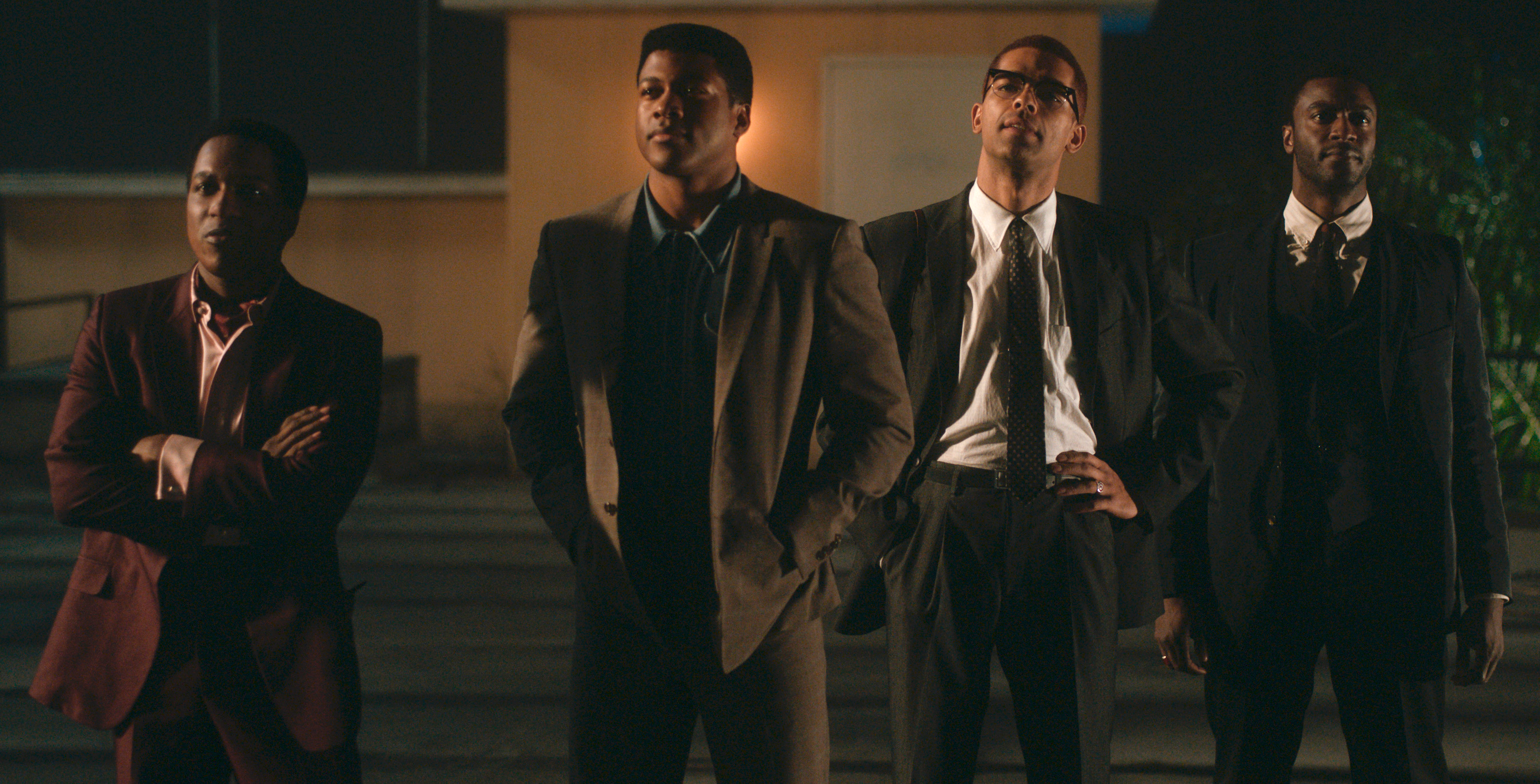
It doesn’t matter how much of the movie One Night In Miami is historically accurate. The conversation presented here shines a light on what these four influential black men might have been thinking at this key point in time. And on where our country and our culture was headed.

Malcolm X (Kingsley Ben-Adir), Cassius Clay (Eli Goree), Jim Brown (Aldis Hodge) and Sam Cooke (Leslie Odom, Jr.) gather in Malcolm X’s Miami hotel room late in the evening of February 25, 1964 after Clay has defeated Sonny Liston to claim the heavyweight title.

Will it be a party with booze and women? Well, no. Malcolm X, a practicing Muslim,  has supplied his room with… ice cream! Oh, boy!

Each of the men has accomplishments to be proud of but feels the challenges of dealing with an America still dominated by white society. Clay has just upset the heavily favored Liston. Cooke is a consistent hit maker. Brown has begun a movie career to go along with his NFL success. X is about to launch his offshoot of the Nation of Islam.

Like other movies that are adapted from stage plays, efforts are made to liven up the presentation and make it visually interesting… more than just four guys talking. 

One Night In Miami opens with vignettes introducing the four principles. Clay in a boxing match versus Henry Cooper; Brown in a conversation with a Southern racist played by Beau Bridges; Cooke failing to win over a white crowd at the Copacabana; Malcolm X and his wife discussing his falling-out with Elijah Muhammed. 

A trip to the hotel’s roof partway into the conversation, ostensibly to check out those who are surveilling Malcolm X, provides a different setting for the group’s discussions.

The conversation becomes, at times, contentious. The men like and respect one another but also launch a few barbs—some light, some not so light. The most pronounced is Malcolm X’s challenge to Cooke to do more meaningful music.

The film suggests that Cooke followed up on that suggestion by going on to perform his classic hit A Change Is Gonna Come on the Tonight Show shortly thereafter. In reality, that performance came a few weeks before the events of the movie occur.

The actors do, in fact, resemble their real life counterparts. Odom sings Cooke songs beautifully. Goree captures the cadence of Clay’s speaking but his accent, to my ear, sounds more like Charles Barkley’s. 

The film is directed by Regina King who won an acting Oscar for her work in If Beale Street Could Talk. She has directed numerous TV episodes. The script is by Kemp Powers, who also wrote the stage version. 

One Night In Miami begins streaming on Amazon on Friday, January 15, which just happens to be Regina King’s 50th birthday!

Half Brothers

In making a comedy/drama, sometimes it’s hard to balance those two elements. A prime example is the new movie Half Brothers.

The plot setup is not a new one: a person discovers that he or she has a previously unknown sibling. Layered atop that situation in Half Brothers is a story of their father’s immigration from Mexico to the U.S.

Renato (Luis Gerado Méndez) is an engineer in Mexico who finds out that his dad is dying. Although he carries anger at his father because dad left Mexico and never returned, he goes to Chicago to say goodbye.

He learns that his dad has another son, Asher (Connor Del Rio). Renato and Asher are extreme opposites: The straight-laced engineer and the weirdo free spirit. As he makes a deathbed apology, dad sends the half brothers on a road trip/scavenger hunt to find out the whole story of his abandonment of Renato.

Here’s where the comedy/drama balance goes off track. After a heart-tugging opening, the film ventures into a tale of Asher’s goofy behavior (including his adoption of a goat as their traveling companion) versus Renato’s desire to wrap up the mystery and return home to Mexico for his wedding. The movie’s drift back into dramatic territory before its non-surprising ending is clumsy and seems not to jibe with the rest of the movie. 

As I viewed Half Brothers, I kept thinking of the 2010 movie Due Date starring Robert Downey Jr. as a guy on a road trip with a similarly annoying goofball played back Zack Galifianakis. And Asher comes off as a poor imitation of Zack G.

Will the brothers bond and get along? Will Renato make it back in time for his wedding? Will Renato warm up to his distant stepson-to-be? You can probably guess those outcomes.

In its favor, the film is not at all condescending toward Mexicans and and shows a good deal of sympathy for those who attempt to come into the U.S. from Mexico.

Half Brothers is directed by Luke Greenfield whose resumé includes Let’s Be Cops and The Girl Next Door. It is playing at a handful of theaters. When it shows up on cable and streaming platforms early next year, you may find it worthy of 90 minutes or so of your time. It’s an okay movie: not bad, not great. Rated PG-13.

The War With Grandpa

Any movie starring Robert De Niro, arguably our greatest living actor, is worth checking out. Even lighter fare like The War With Grandpa.

In films like Meet The Parents (and its sequels), The Intern and several others, De Niro has shown that he can deliver a deft performance even when he’s not being intense.

The War With Grandpa is family entertainment. Rated PG. No profanity. No nudity. You can take everyone to see this movie. (And you will need to TAKE them because it will be playing, initially at least, in theaters only.) It is silly fun.

Sixth grader Pete (Oakes Fegley) is forced to give up his bedroom and relocate up to the attic when his widower grandfather Ed (De Niro) moves in with the family. Goaded by his schoolmates, the resentful lad declares war on grandpa who fights back. The pair agree to rules of engagement which include no collateral damage. But their back-and-forth mischief involving drones, snakes, hot sauce, a jar of marbles, a remote control car and other forms of aggravation does indeed affect others including mom and dad (Uma Thurman and Rob Riggle).

The cast includes Christopher Walken and Cheech Marin as grandpa’s buds and Jane Seymour as a chum/love interest. Singer-songwriter and Disney Channel star Lara Marano appears as Pete’s older sister.

The family feud leads to a dodge ball battle between Ed and his posse and Pete and his friends. An attempt to patch up differences by going fishing features a low-speed boat chase as the adversaries attempt to elude a game warden. And a Christmas-themed birthday party results in a multitude of unsurprising physical antics.

In any movie that has a child actor in a key role, the question must be asked and answered: Is the kid any good? Yes. Fegley handles his role well and doesn’t overplay as some young actors do.

The comedic De Niro has a different sort of appeal compared to the characters (likeable and otherwise) he has played in films like last year’s The Irishman. But there is real charm and a twinkle in his eyes (along with an occasional smirk).

The War With Grandpa is a bit of fluff. But so is cotton candy and who doesn’t like cotton candy?

The Go-Go’s

Along with all the candidates who want your vote in November, there’s another group that’s campaigning this year: The Go-Go’s, the all-girl rock band, wants to be elected to the Rock’n’Roll Hall of Fame. The new documentary film The Go-Go’s makes that point perfectly clear and may well serve to earn them serious consideration.

The film, like many such retrospectives, has plenty of archival “back in the day” footage but the contemporary comments from the individual group members are sharper in tone and more candid than one might expect. Not only do the Go-Go’s talk about their drug use, the film shows them consuming.

The Go-Go’s, whose hit songs are mainly bouncy pop, began in the L.A. punk scene. As the band evolved they transitioned away from the edgier music. A road trip to England where they opened shows for a couple of ska bands provided a bonding experience and gave them confidence to win over challenging audiences.

(Although the film does not make the reference, that trip reminded me of the stories of the time the Beatles spent in Hamburg, Germany in the early 60’s shortly before they broke worldwide.)

Along with those candid comments from the five core women of the band, director Alison Ellwood includes sound bites from women who were fired from the band, the band’s original manager, record company folks, some of those ska musicians and entertainment reporter Chris Connelly.

The Go-Go’s career trajectory paralleled that of MTV. They provided eye candy for the channel, which was a key factor in their ascent. Group members recall not thinking the video for the song Our Lips Are Sealed was that important but later realizing that it was a vital part of their development. As were the Rolling Stone magazine covers. (Remember MTV’s Martha Quinn? She gets a bit of face time to offer her takes on the band.)

Interestingly, lead singer Belinda Carlisle, who was, in my opinion, the prettiest of the group when they were making hit records, has not aged as well as the others. Belinda is still attractive but she has that Priscilla Presley “too much plastic surgery” look.

How important are the Go-Go’s in the history of pop music? Well, they were the first and only all-female band to have the number one album on the Billboard chart. But personal rivalries and jealousies, not to mention drug use, caused the band to break up just a few years after their big debut.

Is that singular chart achievement negated by their lack of career longevity? I think you could argue that either way. But when you scroll thru the list of 230 something performers in the Rock Hall, it would appear that the Go-Go’s qualify for inclusion.

Presuming this film will be seen by Rock Hall gatekeepers, expect them to make it. Soon.

An American Pickle

Where’s the line between “heartwarming” and “sappy?” Hard to say. One person’s “tender, sweet, sentimental” is another’s person’s “sickeningly mushy and syrupy.”

An American Pickle starring Seth Rogen hits the right heartwarming notes without going over the line. It’s the story of an East European Jew who immigrates to America, spends a century in a sort of suspended animation and comes back to life in our new and strange modern time.

The movie is funny but not laugh-a-minute funny. The movie is sweet but not quite Hallmark sweet.

A couple of decades into the 1900’s, Herschel Greenbaum (Seth Rogen) falls into a vat of pickles, just as the Brooklyn pickle factory he works for is being condemned. The vat is sealed and sits undisturbed until a hundred years later when it is opened and there is Herschel, perfectly preserved in the salty brine.

In short order he is introduced to his great grandson Ben (also Seth Rogen), Herschel’s only surviving descendant. They bond but soon find fault with one another. Herschel’s Old World ways get them both arrested for assault and the criminal record results in Ben’s being turned downed for money to market the app he’s spent years developing.

Herschel, who initially stays with Ben, moves out and begins to brine cucumbers into pickles. He sells them from a sidewalk cart and becomes a social media sensation. Ben then schemes to sabotage his great grandfather’s success. Their relationship suffers a number of ups and downs until things are resolved.

Herschel has a full beard and wears vintage clothing. Ben is not quite clean-shaven—he has a bit of facial fuzz—and wears modern casual attire. There is a case of confused identity that is key to the storyline.

Rogen does a great job of playing opposite himself. For most scenes, each actor’s lines are shot separately and spliced together. But some have the two men onscreen at the same time. Actors who’ve done this in the past have spoken of the difficulty of getting the timing and the responses right when playing against a phantom whose parts will be included later. Rogan makes those scenes work just fine.

An American Pickle is a pleasant amusement. The likable Rogen, now just a couple of years shy of 40, continues to expand the scope of characters he plays well beyond the drugged-out goofball types he was earlier known for playing. The film is currently streaming exclusively on HBOMax. I would not be surprised to see it available on HBO on cable within a few weeks.

The Swamp

The new HBO documentary The Swamp has a big surprise: the filmmakers treat Republican congressmen with respect! Where’s the snark? Where’s a narrator sighing a putdown of Florida representative Matt Gaetz, a young firebrand and Trump loyalist? It’s not there!

Gaetz gets the most facetime in this film but Kentucky congressman Thomas Massie and Colorado rep Ken Buck, both Republicans, are also profiled.

The gist of the show is that these guys and a few allies on the Democrat side of the aisle are in D.C. to shake things up and reform the way things are done at the Capitol, especially in terms of fundraising.

Massie defies a GOP stereotype in that he is a fierce environmentalist who drives a Tesla and has a home in Kentucky that gets all its energy from renewable sources. He partners with longtime Democrat congresswoman Barbara Lee in working to rescind the authorization to use military force which Congress gave the president in the wake of 9/11.

Massie also takes the camera crew to the front door of the Republican National Congressional Committee building where, he says, he does not want to depend on that group for campaign money.

Representatives Ro Khanna (D-California) and Matt Gaetz (R-Florida)

Gaetz is seen buddying around with California Democrat Ro Khanna. Gaetz good-naturedly teases Khanna about representing Silicon Valley but not wearing an Apple Watch.

Gaetz also defends former California Democrat representative Katie Hill who resigned after nude photos of her were posted online. He speaks out against her ex’s “revenge porn.” The two are seen sharing a friendly dinner at a D.C. Italian restaurant.

An important contributor to the topic of congressional reform is Lawrence Lessig of Harvard Law School who offers historical perspective and thoughts on how things should change. Lessig blames former House Speaker Newt Gingrich for igniting Congress’s current obsession with fundraising.

My guess is that The Swamp will be summarily dismissed by some liberal viewers because of the way it treats its Republican subjects. Not exactly an adoring portrayal of Gaetz and company but a relatively even-handed approach. To such individuals who themselves often preach tolerance, I’d suggest you try to tolerate this film. You may hate it—especially Gaetz’s fawning phone calls to Trump—but you may also find a nugget or two of enlightenment about the way Congress works.

The Swamp, co-directed by Daniel DeMauro and Morgan Pehme who collaborated on the 2017 Netflix documentary Get Me Roger Stone, is currently being shown on HBO and is streaming via HBOMax.

St. Louis Filmmakers Showcase: Food and Wine

Cinema St. Louis is running its annual St. Louis Filmmakers Showcase online this year. For all the information on how to view these films, click HERE.

Three short documentary films in the Showcase take viewers to an urban vegetable farm, a downstate cattle farm and Missouri wine country. They’re included (along with a 4-minute Goat Yoga film) in the group Doc Shorts 1: Food, Wine and Nature. The films in the Showcase can be viewed on demand anytime from July 10 through July 19.

The filmmakers here face the battle almost every documentary filmmaker must address: the amount of screen time given to talking heads versus the amount of time other visuals are used to tell the story. For the most part, these folks get the ratio right. Each film runs right around 15 minutes.

The most satisfying of the three is Growing For Good from Van Nguyen and Morgan Paar.  A farm in St. Louis’s Central West End grows vegetables and gives them away. The farm’s founders and its volunteers (including 4th graders from a local private school) talk about what it means to work the farm.

The people who run and patronize a local food pantry offer their appreciation for the efforts of the folks who grow the food and for the vegetables themselves. Among the great looking veggies harvested and delivered are okra, tomatoes, radishes, eggplant and the one most requested… Well, you’ll have to watch the film to find out what’s #1.

Austin Williams is a man who spent a year as a teacher but hated it. He bought a 460-acre farm near Greenville, Missouri where he raises cows and sheep. The Honest Work Of Farming from filmmaker Rickie Ross documents what goes into a day of farming, starting with an early wake-up each day. Milking his cows and grazing his cattle and sheep is a labor of love for Williams who says his career transition is “one of the best decisions I ever made.”

Missing from the film are comments from Williams’ wife who is shown with their infant but never heard. Is she as enthusiastic about farming as her husband is? Also, how’s business? Is the farm making money? Are there significant challenges or is farming just continual bliss for Mr. Williams? Sure, it’s a short film, but a tad more info would be nice. (By the way, the drone footage of the farm is gorgeous.)

Missouri Wine: The Lost Years from Julia Doyle incorporates archival footage from those horrible years of prohibition when federal agents not only poured out bottles and barrels of wine but also destroyed winemaking implements. They even ripped out thousands of acres of vineyards. The momentum that Missouri had as a wine region was stopped cold.

The story of the comeback of Missouri wines over the last century is related by Glenn Bardgett of Annie Gunn’s restaurant, Chuck Dressell of Mt. Pleasant Winery, Paul Leroy of Hermannhof Winery. The challenge of convincing wine drinkers that Missouri wines are of high quality is ongoing. But the three gents here have an optimistic outlook on the wines coming from Augusta, Hermann and vicinity.

The URL for these films is cinemastlouis.org. For the Showcase, click HERE.

Surprise!!! (Some movie likes and dislikes)

grayscale-portrait-photo-of-shocked-woman-1201758

I hate it when reviewers mention that a movie has a “surprise twist.” Well, it doesn’t have one anymore, buddy! Because now, thanks to you, (spoiler alert) it’s NOT a surprise!

Ditto for mentioning in reviews that a movie has cameo appearances. Especially when the reviewer mentions the names of those who are making the cameos.

Even worse, when studios release trailers that pretty much tell you the entire plot of the film. Or even worse than that, a trailer that reveals a comedy film’s three or four funniest lines.

In old movies (and lots of old TV shows), I hate scenes set outdoors that are shot on a sound stage, often with fake trees and painted backdrops. I understand that it’s easier to control lighting and audio in an indoor environment, but it looks chintzy.

Also in old movies, I hate RP. Rear projection. A projected background image to indicate that a car or other vehicle is moving while the actors are in a stationary vehicle on a sound stage. I understand that cameras were bigger and bulkier in the old days but directors with decent budgets should’ve gone to the trouble of making their travel shots look real.

I hate that writers don’t get enough credit for the stories they create. Take North By Northwest. One of Hitchcock’s best known films, with a plot and iconic shots that are still appreciated 61 years later. But do you know the name of the person who came up with the original story and wrote the script? I bet you don’t.

I hate it when TV channels or streaming services shortchange the credit crawl at the end of a movie by shrinking it or just going on to the next element. Mainly because it disrespects all the crew members who are due a bit of recognition. And sometimes there are reasons to stick with the credits—take, for instance, Monty Python movies. And Marvel films. I may not care who the gaffer was but I might like to know who did that song I liked. My old radio friend Robert Murphy told me he stays for the credits because he likes to look for good on-air deejay names.

Speaking of crew members… Even when a movie is not as good as might’ve been hoped for, we should recognize and appreciate that many people worked hard to make the film. Yes, it’s a glamorous biz, but it’s still work. Although everybody involved in the making of the film Downhill owes us all an apology. (Just kidding!)

Regarding documentaries… The best documentaries are the ones that have a definite point of view. An agenda. When Michael Moore makes films, he is not looking to present the unvarnished, organic truth, he is looking to present his angle on the information at hand. You may not agree with what his films say, but at least you know where he stands. People may think that just because a film is labeled “documentary,” it presents the real story. No, it presents a version of the truth.

I hate it when we are told that a certain actor or actress was offered an iconic role that they turned down. Because we are usually not told if the actor was had a firm legitimate offer, if the actor (or his/her agent) was contacted to see if she/he had any interest in the role or if someone casually mentioned at a party that “you’d be perfect in this new film I’m making.” My guess is lots of these stories we hear are the result of simple feelers. Or, though the actor would sound like a dick if he/she said so, the amount of money offered was less than he/she wanted. I’ve had many conversations and meetings with prospective employers in my career—some were legit offers, some were feelers, some were worthless.

I am happy that Parasite got the Oscar for best picture back in February. It is an excellent film: great story, great cast. And it has… subtitles! Let’s hope the success of Parasite in the U.S. leads to more foreign films WITH SUBTITLES being accepted and viewed by American audiences.

Subtitles are good. A highlight of watching movies on my TV during the pandemic has been the availability of subtitles on most movies. I am not deaf. I can hear. But I cannot always hear things clearly. Sometimes actors’ lines are spoken softly or mumbled (hello, Casey Affleck!) and are hard to discern. Subtitles help. If studios would distribute NEW MOVIES WITH SUBTITLES for theatrical release, that would be awesome! (Maybe theaters could run the subtitled versions as an occasional alternate to the regular versions?)

I hate it when moviegoers complain about small inaccuracies in films that are based on or “inspired by” actual events. To tell a story in roughly two hours, filmmakers may have to combine events and even characters. These composites exist to move the story along and to simplify the details for a movie audience. If this “license” significantly changes the movie, then there may be cause for concern. (A print version—book, magazine/newspaper article—of those events will likely deliver those missing details, should you want them.)

I try not to get upset anymore about who wins awards. They do not always go to the best performances or scripts or costumers, etc. The voting is often political and winners may be the individuals with the most friends or the most influence in the biz. The awards shows can be amusing to watch, despite the moments of extended tedium. I’ve attended a few country music industry award shows in Nashville and Los Angeles and, while the shows themselves are entertaining, the real fun is at the after parties.

Having said that, I still think Michael Keaton (for Birdman) should’ve won the Oscar over Eddie Redmayne (for The Theory Of Everything). Redmayne, of course, followed the advice of Kirk Lazarus (Robert Downey Junior) in Tropic Thunder and did not, in his portrayal of Stephen Hawking, go “full retard.”

You probably heard that it sucks. And you may be too cool to be seen watching it. But… the Cats movie was not THAT bad. It had its moments. And some big stars. And fresh face (and voice) Francesca Hayward. Check it out, if only to “hate watch” it and see what people are seriously disliking. I mean, if a film is this polarizing (2.7 rating on imdb.com—ouch!), there must be a reason, right?

Sorry for more dislikes and likes in this post. I’ll try to reverse the ratio next time. Be safe.