The Housemaid

An ad for the new movie The Housemaid suggests that moviegoers will want to see this film for a second time. Presumably to piece together all the film’s plot elements. 

Once is enough for me. The film’s “bloody violent content” is a smidge over-the-top for my taste. YOU, on the other hand, might be totally okay with it!

The Housemaid is a suspenseful, psychological thriller. The stars are attractive. All are talented. The story is unraveled cleverly. And, along with the tension, The Housemaid even has a few chuckles. Good movie. Just grisly.

There are signals early on in the story that things in this beautiful house are not quite right. Would a suburban housewife like Nina (Amanda Seyfried) actually hire as a housemaid a woman who looks like Minnie (Sydney Sweeney)? Especially when she has a handsome hunky husband, Andrew (Brandon Sklenar) who is a perfectionist?

It’s soon revealed that Minnie is a recently paroled convict who is sleeping in her car. She needs the gig, even if her rather spartan room is at the very top of the house. Minnie works hard to keep Nina pleased with her work, despite her uneasiness with Nina’s erratic behavior.

As the tale unfolds and more is revealed, we learn things about Andrew, his man cave (where he likes to watch of episodes of Family Feud) and his controlling mother (Elizabeth Perkins). And what about the swarthy handyman (Michele Marrone) seen lurking in the yard doing random tasks? And Cece (Indiana Elle), Nina’s daughter from a prior relationship?

NO SPOILERS HERE! What transpires in The Housemaid are events you might have guessed were coming. But you will enjoy it more, I think, if you just allow things to happen and let yourself be surprised/amazed by what unfolds.

The Housemaid is directed by Paul Feig who knows how to assemble a suspenseful movie. Writer is Rebecca Sonnenshine from Freida McFadden’s novel. The Housemaid is rated R for “strong/bloody violent content, sexual assault, sexual content, nudity and language.” 

Hamnet

Jessie Buckley! Bravura performance! Awards worthy!

Hamnet (not a typo) is slow, dark and moody. But, like the words you sometimes see posted next to online videos, “wait for the end!” Not to spoil things, but the third act of this new movie serves up a nice payoff.

Agnes (Buckley) is an earth mother, a free spirit type of woman. A birder. She even has a glove she wears to keep talons from piercing her arm. She runs through the woods.

Will (Paul Mescal) spots her, they hook up, marry and have three kids. Two girls and a boy, Hamnet. They live in a woodsy idyll with family close by. Emily Watson appears as Will’s mom Mary. Will, by the way, is Will Shakespeare.

Childbirth is not always easy, even in our modern times. 440 or so years ago, it was a real challenge, especially so for Agnes. And then, to lose her beautiful boy… 

Well, speaking as one who knows, the loss of a child, at any age, brings a pain that is unfathomable. The hurt is palpable, emotionally and even physically. 

Agnes grieves. Will grieves. Following the death of their young son Hamnet, Will goes back to London where he writes and stages his classic tragedy, Hamlet.

The depiction of the Globe Theater in the film is impressive. The real Globe exists in London but was deemed not appropriate for Hamnet. The one is the movie was built especially for the film. But it gives a good feel for the intimacy of the Globe, back in the day.

Interestingly, the man who plays Hamlet (in the stage play) is Noah Jupe who is the older brother of Jacobi Jupe who plays young Hamnet. 

Hamnet is being marketed as a mass appeal type of movie but it does still have a tinge of artsy-fartsy. Yes, it delivers an emotional punch and yes, the acting is superb. It has its sweet, light moments. But the feel is that this is an “important” film, which is something you should know going in. 

Hamnet is one of the answers to the question: Why don’t they make movies for grownups anymore? Well, they do. And this is a movie for grownups. (AARP recently published its annual list of “Movies for Grownups” and Hamnet is included.)

Hamnet is directed by Chloe Zhao who co-wrote the script with Maggie O’Farrell who wrote the novel that the movie is based on. Hamnet is rated PG-13. 

Conclave

Conclave is an excellent movie, one of the year’s best. Compelling story, stellar cast, deft directing. It’s a winner, a “must see.” But… be careful!

There are people who will reveal certain key plot points. And not just on social media platforms. Because Conclave is a story about the election of a pope, some Catholics—church leaders and church members—may not care for the less-than-flattering depictions of certain cardinals.

Conclave is fiction but it considers the real life conflicts within the Catholic religion between its progressive and conservative elements. The election of a new pope is a political process with similarities to governmental elections: divisions into factions, surprise disclosures, accusations and denials, downright dishonesty. 

Cardinal Lawrence (Ralph Fiennes) is tasked with leading the election process. It’s a portrayal that will net him awards. Fiennes was Oscar nominated for The English Patient and Schindler’s List. This may be the one that gets him the trophy.

His speech to his fellow cardinals at the conclave just before the first balloting is a classic scene that he nails beautifully. As revealed in the trailer, he says, “If there was only certainty, and no doubt, there would be no mystery. And, therefore, no need for faith.” Not sure if the source of this monologue is the screenwriter Peter Staughan or book author Robert Harris but it is impactful.

Others who play key roles are Cardinal Bellini (Stanley Tucci), Cardinal Tremblay (John Lithgow), Italian Cardinal Tedesco (Sergio Castellito), African Cardinal Adeyemi (Lucian Msamati), Cardinal Benitez (Carlos Diehz), and Sister Agnes (Isabelli Rossellini). Also, as Lawrence’s assistant O’Malley, Brian F. O’Byrne. Quite a lineup and they all get to shine.

Conclave is in some ways an old-fashioned movie. No nudity, no sex. No profanity. No superheroes. A story that unfolds in chronological order without flashbacks. A killer soundtrack from Volker Bertelmann that amplifies the tension and suspense. And multiple memorable visuals from director Edward Berger and his crew.

The warning posted at the top of this review bears repeating. Beware of spoilers. Conclave will generate conversation and beans are likely to be spilled. Be cautious where you click.

How will Conclave play among Catholics? My guess is that reactions will cover a wide spectrum from warm embrace to dismissive putdown. On one hand, it’s a deep and illuminating dive into the pope choosing process that may be appreciated by some church members. On the other hand, it deals with backstage maneuvers in church headquarters that some folks just don’t care to know about. The responses could get interesting. Stay tuned.

Conclave is rated PG.

It Ends With Us

It Ends With Us, the new film adapted from Colleen Hoover’s 2016 best selling novel, is a cautionary tale. For some, it may even be instructive.

The “it” in the title is the cycle of spousal abuse which sometimes continues through generations. The movie does have many light moments and some semi-steamy romance but there’s also a dark undercurrent. 

Lily Bloom (Blake Lively) is a thirtysomething Bostonian who returns home to Maine after her father’s death. At his funeral when she is asked to say a few words about him, she has nothing. Why? It is soon revealed that her father was physically abusive to her mom.

Lily meets Ryle Kincaid (Justin Baldoni) a Boston surgeon and a slowly simmering romance ensues. Lily gets signs that Ryle has a temper. In fact the first thing she sees him do is kick a chair in anger. 

Lily opens a flower shop and her first employee Allyssa (Jenny Slate) just happens to be Ryle’s sister who shares insight into her brother’s behavior.

Meanwhile, Lily’s old boyfriend from her hometown Atlas (Brandon Sklenar) reappears in her life when she and Ryle dine in his (Atlas’s) new restaurant. When Lily shows up later at Atlas’s joint with a bit of a shiner, the result of an overreaction by Ryle to a kitchen disaster, Atlas confronts Ryle. When Ryle later discovers that Atlas has given her his phone number in case of trouble, he gets upset again.

Lily has flashbacks to life back in Maine and the tension in her household. She also recalls her early times with Atlas. Young Lily (Isabela Ferrer) and young Atlas (Alex Neustaedter) also experience her dad’s volatile temper.

It Ends With Us maintains a simmering level of tension from start to finish. Lily’s mom tells her daughter that she loved her husband despite his abuse. Lily offers Ryle forgiveness for his transgressions. But how far will that go? What role will Atlas play in her encounters with him now that they are both adults? 

Blake Lively carries the film in a role that has her portrayal of Lily cover a spectrum of character types ranging from a sexy babe to a hustling business owner to an assertive woman who takes control of her life. She’s good!

Coleen Hoover has said that the story is based on the relationship of her mother and father. And that it was hard for her to write. Its success has spawned a sequel book and helped make Hoover a fan favorite.

A best-selling novel that generates a lot conversation should deliver a built-in audience for the film version. But since more people see movies than read books, the word-of-mouth opinions from early movie goers will determine if It Ends With Us has legs. I’m guessing it will. 

Rated R. Directed by the guy who plays Ryle, Justin Baldoni.

Oppenheimer

It’s too early to pencil in Oscar winners’ names but it’s easy to imagine Oppenheimer pulling down a few next March. Starting with Christopher Nolan who wrote and directed this epic film. Is it his best film to date? Maybe. Among his top three, for sure.

Two weird trends this summer: baseball games have gotten shorter and movies have gotten longer. Oppenheimer is a three hour movie but screenwriter Nolan delivers huge amounts of narrative in those 180 minutes. And director Nolan maintains a fierce pace with multiple time jumps to tell that story. A clever device he employs is purposeful shifts between color and black-and-white sequences.

What about Cillian Murphy as Robert Oppenheimer? He’s been great in smaller movie roles and in the TV series Peaky Blinders. Although Murphy’s is not a household name, Nolan made a wise choice in giving Murphy the mantle of carrying this film. Not unlike the way the U.S. Army’s Leslie Groves (Matt Damon) chooses Oppenheimer to run the Manhattan Project despite the physicist’s baggage. 

Part of that baggage is his alcoholic wife Kitty (Emily Blunt) who is a Communist. As is Robert’s brother Frank (Dylan Arnold). A needy lover, Jean Tatlock (Florence Pugh), also has red connections. Is Oppenheimer himself a Communist sympathizer? He contributed to revolutionaries in Spain. He tried to organize a faculty union at Cal. But his work as a physicist makes him the right man to head the development of the atomic bomb at Los Alamos.

The role of Lewis Strauss includes some of the best Oscar-bait dialogue since Jack Nicholson took the trophy with his “you can’t handle the truth” speech in A Few Good Men (which took Best Picture in 1992.) Robert Downey Jr. is up to the task of portraying a complex individual who is less well-known than the film’s title character. 

Much of Strauss’s screen time revolves around hearings for his nomination to be U.S. Commerce Secretary during Ike’s second term. He also recruited Oppenheimer at Princeton and later was head of the Atomic Energy Commission. 

Jason Clarke as AEC attorney Roger Robb has another role that  allows for some scenery chewing. His confrontations with Oppenheimer and others during an inquiry into Oppenheimer’s fitness for continued security clearance are forceful and direct.

Among the films large cast, players include Kenneth Branagh, Alden Ehrenreich, James D’Arcy, Matthew Modine, Josh Hartnett, Casey Affleck, Dean DeHaan and Rami Malek. Tom Conti appears as Albert Einstein and Gary Oldman portrays Harry Truman.

Sound plays a major role in Oppenheimer. The dynamic range between ear-splitting loudness and calming silence is finessed beautifully by Nolan and the film’s sound crew. Expect a few awards nods to the craftspersons who make the movie sound good. Ludwig Goransson’s music provides momentum and adds to the intensity of numerous scenes. 

Because of Vladimir Putin’s invasion of Ukraine and saber rattling by both the U.S. and Russia, Oppenheimer is not just entertainment but also a timely movie. Although the film is a dramatization of real events, there’s a foundation of truth here that provides useful information for all Americans, especially younger citizens. 

Twenty-first century perspectives have revised our views of much of our nation’s history including our participation in wars. The paradox of the atom bomb’s being a good thing (ending hostilities with Japan) and a horrible thing (killing thousands of civilians) is one that has been and will be constantly examined. Oppenheimer is now part of that discussion. 

The movie is likely to make Cillian Murphy a genuine star for his strong performance. If you’re going to be onscreen for that much of a movie, you’d better be good. He is. Will he receive awards consideration? Bet on it.

Oppenheimer will bring fresh individual accolades to Nolan and Downey, among others. And the film itself is a likely Best Picture nominee. It is, as they say, a MAJOR motion picture!

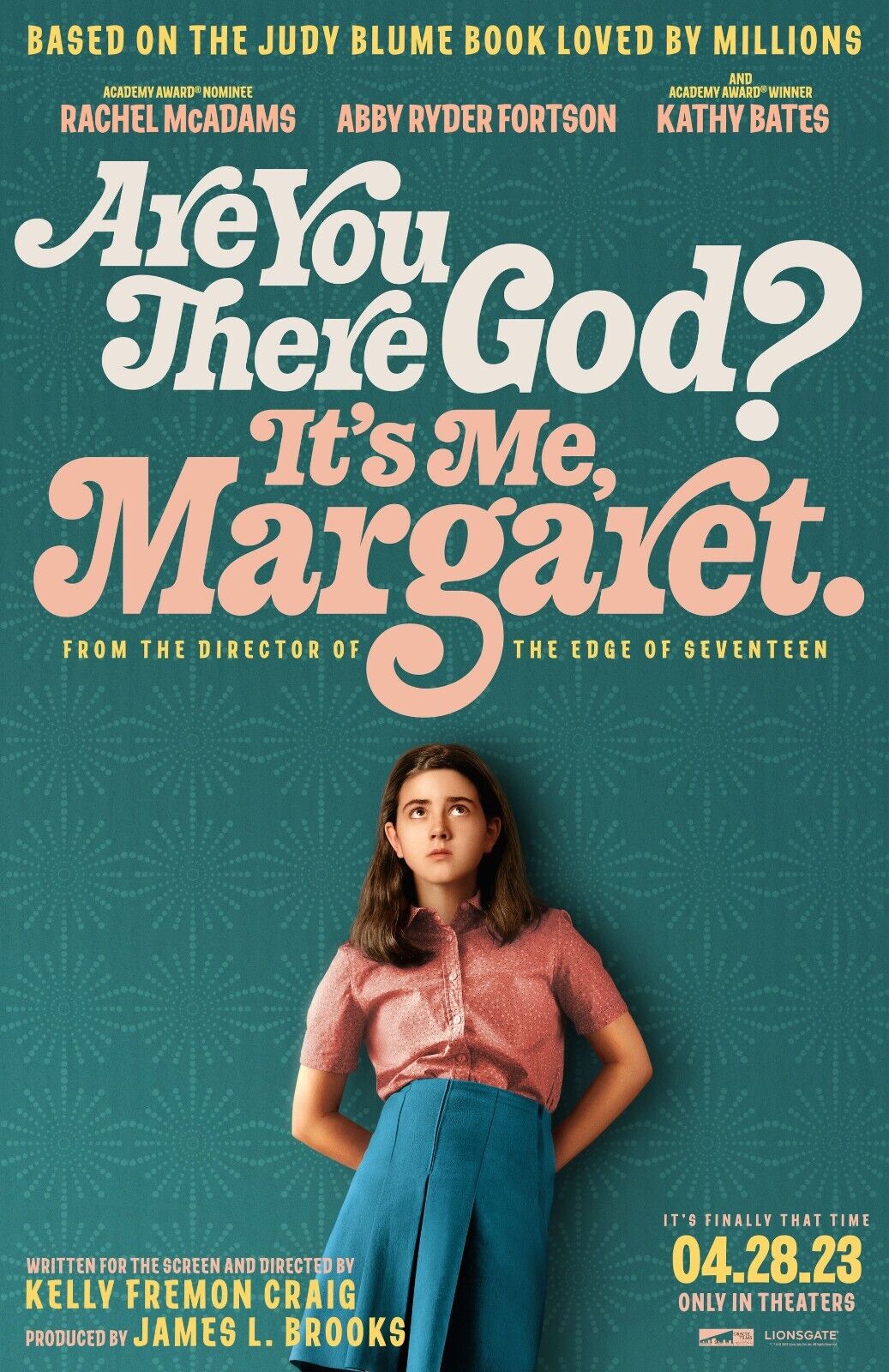
Are You There God? It’s Me, Margaret.

Is it as good as the book? Short answer: No. Because movies adapted from books are never as good as the book. Well, almost never.

But is it a good MOVIE? Yes. Entertaining. And, yes, charming.

Along with beginning to mature into a new life stage, Margaret (Abby Ryder Fortson) has to handle a move from New York City to the Jersey suburbs AND a spiritual awakening. The film’s other title character, God, gets significant attention in the story. Margaret’s frequent prayers and religious exposure from her grandma (Kathy Bates) and friends open her mind to new ideas and concepts.

Margaret’s parents are a Christian mom (Rachel McAdams) and a Jewish dad (Ben Safdie) who have chosen not to raise their daughter in either religion. This leads to an ugly episode when Margaret’s maternal grandparents come to visit.

Margaret’s interactions with her friends Nancy (Elle Graham), Janie (Amari Price) and Gretchen (Katherine Kupferer) are the highlights of the film. Their meetings in 2023 would likely be conducted via text messaging or other cyber connections. It’s nice to see them hang out in person in their 1970 world.

The important question here is: can a story set half a century ago still be relevant in our more sophisticated modern day? Absolutely. Sixth grade girls in 2023 are vastly different from those of 1970 but much of this tale is about the things all girls—and their parents—deal with as they transition from childhood into puberty.

Today’s girls are much better informed about many things, receiving details from their peers who are better informed than Margaret’s peers were. And, of course, the internet provides info. And today’s school libraries offer materials that tell girls more than was available back in the day.

Also, can a male moviegoer relate to this story of a young girl who is anxious about getting her first bra and her first period? Puberty is a weird time for boys, too, but women will identify with the film’s central characters and their travails more closely than most men might. 

Director Kelly Fremon Craig is to be credited for not overplaying the nostalgia aspect of the production. There are old cars, telephones with cords, girls wearing skirts and dresses instead of slacks, etc. But we’ve seen other filmmakers take the nostalgia route to such an extent that it distracts from the story. Craig, who also scripted the film, does an admirable job of weaving character development with storytelling in a quick-moving hour and forty-five minutes.

Fortson handles well her duty of carrying the title role which is always a concern with juvenile actors. Her talent is obvious. And she’s a cute kid without being cloying. Graham who plays Nancy is impressive as well and her career, too, bears watching. And McAdams always adds to any film she’s in. 

Are You There, God? It’s Me, Margaret. is rated PG-13. Might be okay for some preteens but that’s where your parental guidance comes into play.